Checked on 23 September 2026 against the Ministry of Health, Labour and Welfare’s pages on public assistance and on the treatment of foreign nationals, the text of the 1954 notice, the MHLW pages on the self-reliance support system, the housing security benefit and the welfare fund loans, and the Immigration Services Agency’s renewal and permanent residence guidelines.
The short answer
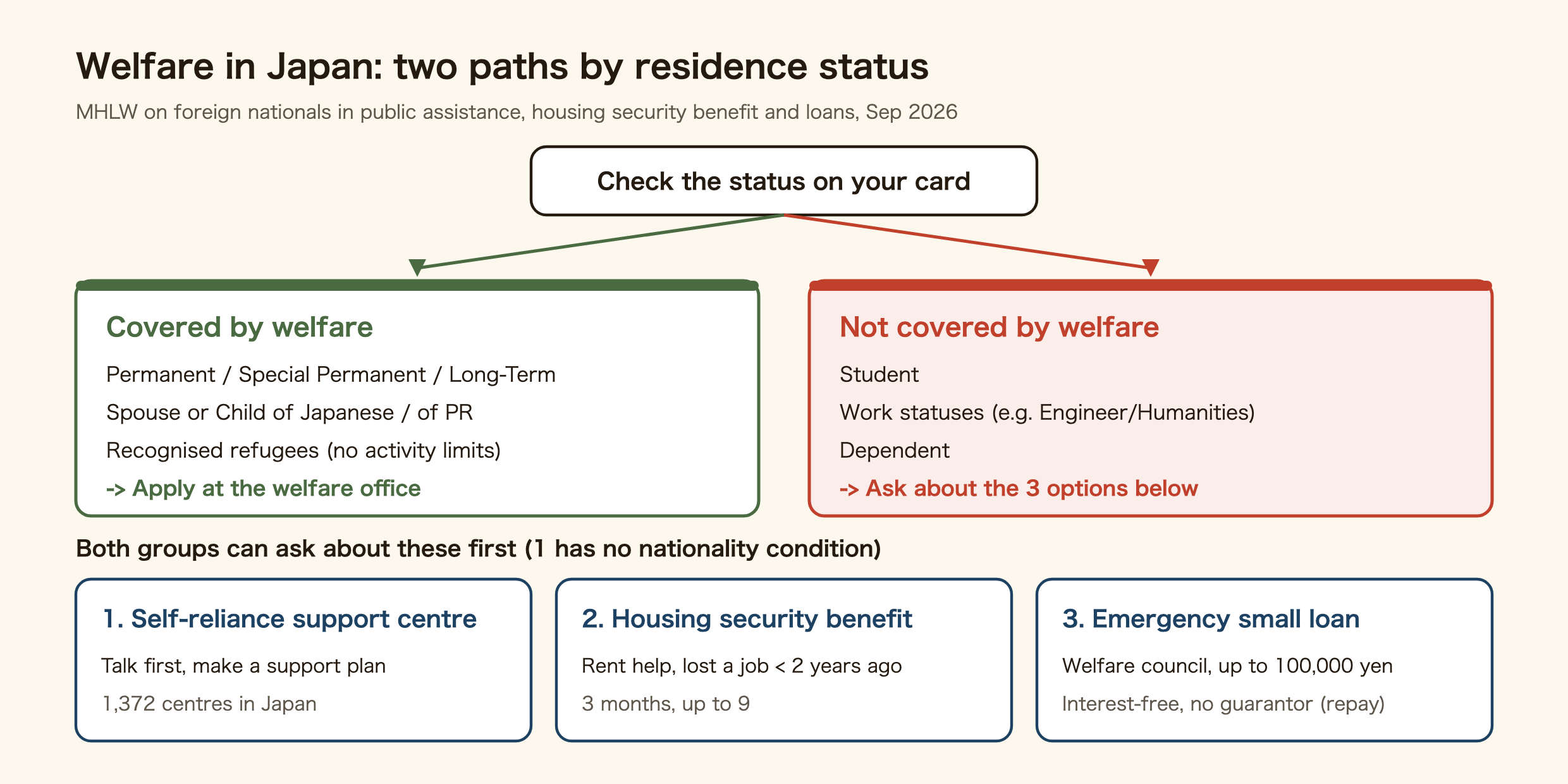
- Some foreign residents can get welfare (seikatsu hogo) in Japan. The Ministry of Health, Labour and Welfare lists Permanent Resident, Special Permanent Resident, Long-Term Resident, Spouse or Child of a Japanese National, Spouse or Child of a Permanent Resident, and recognised refugees — statuses with no limit on what you can do in Japan.
- Student, work visas and Dependent are not on that list. Instead, go to a self-reliance support centre, which has no nationality condition, and ask about rent support (the housing security benefit) and emergency loans.
- You apply at the welfare office for the address on your residence card. Show the card and write your nationality on the form. A decision normally comes within 14 days.
- You receive the gap between the minimum cost of living and your income. For a family of three (33, 29 and 4) in central Tokyo, the living allowance is 165,360 yen a month, with rent paid on top.
- Visa renewal looks at whether you are a “public burden”, but humanitarian reasons are also weighed. Nothing says receiving welfare means automatic refusal.
Knowing this, you can tell whether your status lets you apply, and if not, which door to knock on today — before the rent runs out. You will also know what Immigration may ask about at your next renewal or a permanent residence application.
Your contract ended three months ago. No new job yet, and your savings cover two more months of rent. Your marriage is over and it is you and your child now. You ask a Japanese friend whether foreigners can get welfare, and they look unsure. For a Japanese person, welfare is something you ask the city office about. For you, it comes with a second question: what happens to my visa?
- Can foreigners get welfare in Japan? The 6 statuses that qualify
- What are the conditions? The same four as for Japanese nationals
- How much is welfare in Japan?
- How to apply for welfare as a foreigner: the welfare office for your card address
- Does welfare affect visa renewal in Japan?
- What about permanent residence?
- Not covered? 3 things to use before welfare
- Rules while you receive it — and two differences for foreigners
- Is welfare for foreigners being cut? What has and has not been decided
- Which one are you?
- FAQ
- Summary
- Related reading
Can foreigners get welfare in Japan? The 6 statuses that qualify
The Public Assistance Act covers only Japanese nationals. Welfare for foreign residents works differently: under a 1954 notice from what was then the Ministry of Health and Welfare, local governments give foreign residents protection “in line with” the rules for Japanese nationals, as an administrative measure rather than a legal right. The Ministry lists who is covered:
- Permanent Resident
- Special Permanent Resident
- Long-Term Resident (teijusha)
- Spouse or Child of a Japanese National
- Spouse or Child of a Permanent Resident
- Recognised refugees
What these have in common is that you are free to do any work or activity in Japan. The Ministry adds that some other cases can also qualify, such as a Designated Activities status with no limit on activities in Japan.
Student, work statuses such as Engineer/Specialist in Humanities/International Services, and Dependent are not on the list. Each of them is tied to a set activity.
What are the conditions? The same four as for Japanese nationals
Having the right status is not enough on its own. Because protection for foreign residents follows the rules for Japanese nationals, the conditions are the same four.
- Use your assets — savings, or land or a home you do not live in, go towards living costs first. A car is normally sold, with exceptions such as a disability that makes it necessary for work or hospital visits
- Use your ability to work — if you can work, you work as much as you can
- Use other schemes first — pensions, allowances, unemployment benefits
- Family support comes first — if relatives can help you, they are asked
If your household income is still below the government’s “minimum cost of living”, the difference is paid. It is assessed per household. You can receive it while working, if your pay falls short.
One extra check applies to foreign residents: the prefecture confirms that you cannot get help from your country’s embassy or consulate. (The notice says this step is not needed for now for people of Korean or Taiwanese origin.)
How much is welfare in Japan?
There is no fixed amount. Your area and the size and ages of your household set a minimum cost of living, and you receive that minus your income (wages, pensions and so on) each month.
These are the Ministry’s official examples of the living allowance (seikatsu fujo), which covers food and utilities, as of 1 April 2026.
| Household | Central Tokyo and similar | Rural areas |
|---|---|---|
| Three people (33, 29 and 4) | 165,360 yen | 147,370 yen |
| Single parent with two children (30, 4 and 2) | 197,220 yen | 176,300 yen |
| Older person living alone (68) | 77,980 yen | 68,950 yen |
Rent is added as a housing allowance, paid at cost up to a cap. In the Tokyo example for a single person, the cap is 53,700 yen a month (grade 1 areas). Medical care is paid directly to the hospital as a medical allowance, and you pay nothing.
Being foreign does not reduce the amount. The notice says there should be no difference in what is provided.
How to apply for welfare as a foreigner: the welfare office for your card address
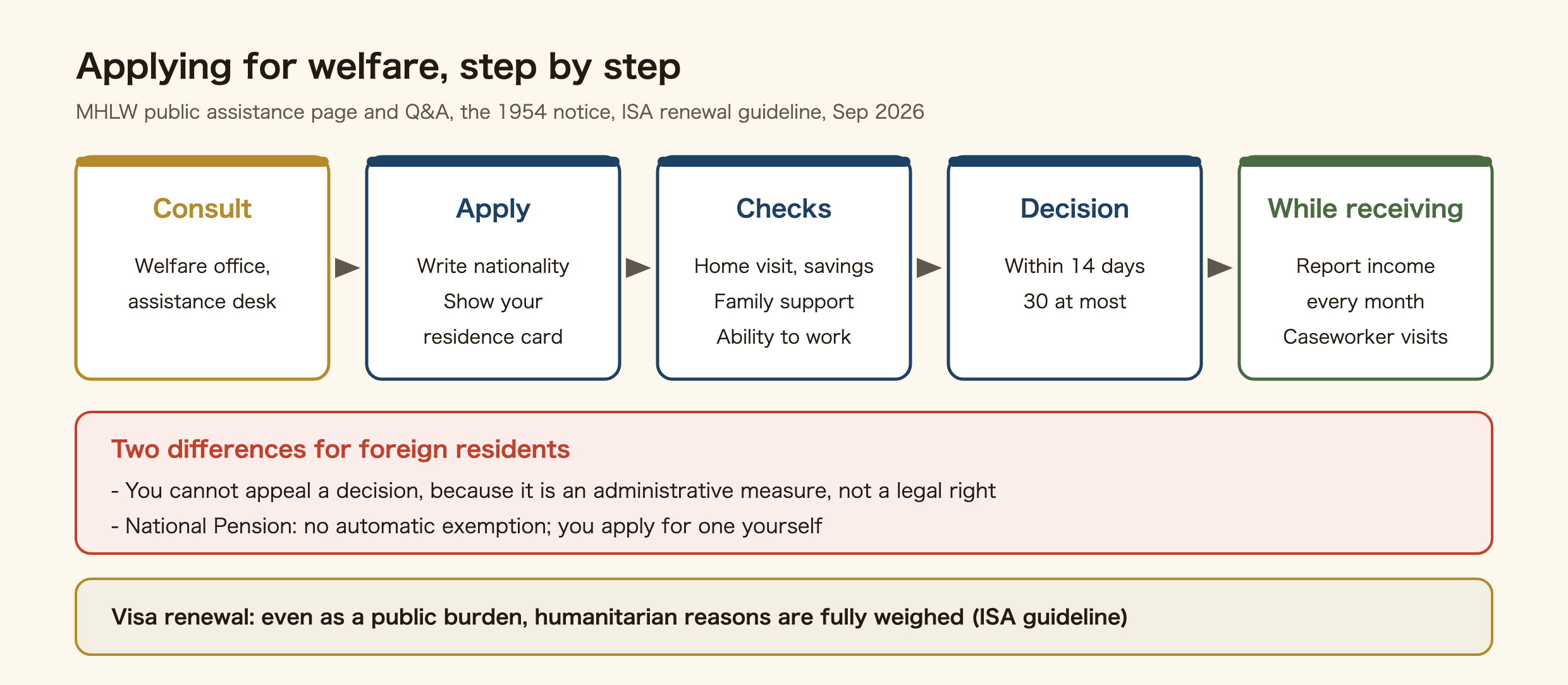
Go to the public assistance section of your local welfare office (fukushi jimusho). In a city or ward, the city or ward runs it. In towns and villages, the prefecture does, and if your town has no welfare office you can apply at the town hall. For foreign residents, the office in charge is the one for the address on your residence card.
- Consult the office. They explain welfare and check what other schemes you can use
- Submit the application. Write the nationality of the applicant and of everyone who needs support, and show a valid residence card (or special permanent resident certificate)
- Go through the checks: a home visit, bank and insurance checks, whether family can support you, your pension and wages, and whether you can work
- Get the decision, normally within 14 days of applying, or up to 30 days if the checks need more time
Bring your residence card, bank book, payslips and rental contract. The Ministry says that if you cannot fill in the form for a special reason, you can still apply without it. If the conversation stays at “consultation”, say clearly that you want to apply.
If you have nothing to live on until the decision, the social welfare council may lend you a short-term bridging loan, according to the Ministry’s Q&A. In a real emergency, the notice allows protection first and paperwork afterwards.
Does welfare affect visa renewal in Japan?
The Immigration Services Agency’s guideline for renewals lists, among the points it considers, having “sufficient assets or skills to make an independent living”. That means you are not a public burden in daily life and your future looks stable, assessed per household.
The same item goes on: even if you are a public burden, where there are humanitarian reasons to allow you to stay, those reasons are fully taken into account. And the points are weighed as a whole; one of them alone does not decide the outcome.
So be ready to explain at renewal why you needed welfare — illness, divorce, losing your job. Keep the medical certificate, the separation notice from your employer and the welfare office’s decision letter. For timing and documents, see how visa renewal works in Japan.
The renewal fee reduction that starts on 1 October 2026 needs two things together: financial hardship, such as receiving protection equivalent to welfare, and a humanitarian ground, such as recognised refugee status. Being on welfare alone does not reduce the fee, so check the new residence permit fees from October and budget for it.
What about permanent residence?
The permanent residence guideline requires that you “not be a public burden in daily life” and have a stable future.
There is an exception. Spouses and children of Japanese nationals, permanent residents and special permanent residents do not need to meet this independent-living requirement. Neither do recognised refugees and some others. For the length of stay, pension record and other conditions, see the permanent residency rules.
For people who already hold permanent residence, a revocation system starts in April 2027. The draft guideline published in August 2026 lists “receiving measures equivalent to public assistance” among the cases that should not count as refusing to pay taxes or premiums. It is still a draft.
Not covered? 3 things to use before welfare
If your status is not covered, there are still places to go. People who are covered can use them first too.
1. Self-reliance support centre: the first stop
This is the consultation desk of the support system for people in financial difficulty. The law’s definition of who it helps has no nationality condition. Staff listen to problems with work, rent, household money or housing, and draw up a support plan with you. There are 1,372 centres across Japan (as of April 2025). Find yours in the national list of centres (Japanese).
2. Housing security benefit: help with rent
This pays rent for people who lost their job or closed their business within the last two years, or whose income fell by a similar amount through no fault of their own. The main conditions:
- Household income at or below the local base amount plus rent
- Savings at or below six months of the base amount (never more than 1,000,000 yen)
- Registering with Hello Work and looking for a job
It is paid for three months, and up to nine with extensions, directly from the local government to your landlord. The cap is the same as welfare’s housing allowance: 53,700 yen a month for a single person in Tokyo’s 23 wards. Asked whether foreign nationals can get it, the Ministry answers that they “may be eligible”. Students are generally not, because they are not usually the main earner (with exceptions).
3. Emergency small loan: up to 100,000 yen
The social welfare council (shakai fukushi kyogikai) lends up to 100,000 yen, interest-free and with no guarantor. It is a loan: after a two-month grace period, you repay it within 12 months. It covers things like living costs until a pension or unemployment benefit starts, or a fall in income from dismissal or reduced shifts.
Each prefecture’s council sets out its conditions for foreign residents. The Kanagawa, Chiba and Osaka councils require a residence status and the prospect of living in Japan long term (or permanently). Ask the council in your city whether you fit.
If you lost your job and paid into employment insurance, unemployment benefits come first.
Rules while you receive it — and two differences for foreigners
- Report your income every month, including part-time pay
- Accept home visits from your caseworker (a few times a year) and follow their guidance
Two things work differently for foreign residents.
First, you cannot appeal a decision. Because protection for foreign residents is an administrative measure rather than a legal right, a Ministry notice says appeals must be dismissed. So bring your income and savings records to the first application and explain your situation in detail.
Second, the National Pension. Japanese nationals on welfare are exempt from premiums just by notifying (the statutory exemption). Foreign residents protected under the administrative measure apply for an exemption themselves instead. The steps are in National Pension exemption. Leaving months unpaid creates a record that renewal and permanent residence reviews can see.
Is welfare for foreigners being cut? What has and has not been decided
The government’s Comprehensive Measures of 23 January 2026 say two things about welfare.
- From June 2027, welfare offices are to check nationality and residence status through My Number data; this is being coordinated between ministries
- As a future task, the government will consider necessary measures, “including a review of who is covered by the administrative measure”
At a press conference on 3 February, the Minister of Health, Labour and Welfare said that no specific policy or schedule has been decided for reviewing who is covered. As of 23 September 2026, the Ministry’s page still lists the statuses in this article.
Which one are you?
- Permanent resident, long-term resident or spouse visa, and money is running out — take your residence card, bank book and payslips to the welfare office. Today, call the city office and ask where the public assistance desk is.
- Student, work visa or Dependent, and the rent is at risk — ask a self-reliance support centre about the housing security benefit and the emergency small loan. Today, find your nearest centre in the list and call.
- Just lost your job and still have some savings — sort out unemployment benefits and the National Pension and health insurance exemptions or reductions first. Today, check with your employer whether your separation notice has been sent.
- On welfare, with a visa renewal coming up — put together the papers that show why you needed support (medical certificate, separation notice, decision letter). Today, mark the date three months before your card expires on your calendar.
FAQ
Q. Can foreigners get welfare in Japan?
Permanent residents, special permanent residents, long-term residents, spouses or children of Japanese nationals or permanent residents, and recognised refugees can receive protection in line with the rules for Japanese nationals. It is an administrative measure based on a 1954 notice, and the conditions are the same as for Japanese nationals.
Q. Can international students or work visa holders get welfare in Japan?
Student, work statuses and Dependent are not on the Ministry’s list. A self-reliance support centre can help you apply for the housing security benefit or the emergency small loan.
Q. Where do foreigners apply for welfare in Japan?
At the welfare office for the address on your residence card. Write your nationality on the form and show your card. A decision normally comes within 14 days.
Q. How much is welfare in Japan?
The gap between the minimum cost of living and your income, on the same standard as for Japanese nationals. For a family of three (33, 29 and 4) in central Tokyo, the living allowance is 165,360 yen a month as of April 2026, with rent paid separately.
Q. Will welfare stop me renewing my visa?
Nothing says receiving welfare alone means refusal. The Immigration guideline says that even if you are a public burden, humanitarian reasons to let you stay are fully taken into account.
Q. Is Japan ending welfare for foreigners?
No specific policy or date has been decided. The government’s January 2026 Comprehensive Measures list a review of who is covered as a future task, but the health minister said in February that nothing has been decided yet.
Summary
Welfare for foreign residents is not a legal right but an administrative measure based on a 1954 notice. It covers statuses with no activity limits — permanent residents, long-term residents, spouse visas, recognised refugees — on the same conditions and amounts as for Japanese nationals. You apply at the welfare office for the address on your residence card, and the decision normally comes within 14 days.
If you are on a student, work or Dependent status, the self-reliance support centre, the housing security benefit and the emergency small loan come before welfare. At renewal, humanitarian reasons are weighed, so keep the papers that show what happened. Going to the desk before the rent runs out keeps the most options open.
Official sources: MHLW, public assistance (Japanese) / MHLW, treatment of foreign nationals in public assistance (Japanese) / MHLW, public assistance Q&A (Japanese) / 1954 notice on public assistance for foreign nationals (Japanese) / MHLW, self-reliance support system (Japanese) / MHLW, housing security benefit FAQ (Japanese) / MHLW, welfare fund loan conditions (Japanese) / ISA, renewal and change of status guideline (Japanese) / ISA, permanent residence guideline (Japanese) / MHLW minister’s press conference, 3 Feb 2026 (Japanese). Checked on 23 September 2026. Always confirm with your welfare office or self-reliance support centre whether you qualify.
Related reading
Found this useful? Share it
Send it to a friend who lives in Japan.
WHO WROTE THIS

mori
Japanese. I read the ministries’ own notices, orders and Q&As in the original, and I start from what my Nepalese and Sri Lankan friends in Japan actually ran into. I do not write about what I have not checked or been told.
What this site can and cannot do →Looking for something else?