Checked on 22 September 2026 against the Children and Families Agency’s child allowance guide and its October 2024 expansion page, and the Child Allowance Act and its regulations (e-Gov).
In short
- Child allowance (jido teate) is money the national government pays every month to anyone raising a child up to the end of the school year in which the child turns 18, and foreigners get it on exactly the same terms. Your visa type is irrelevant. What decides it is whether you and your child are registered residents.
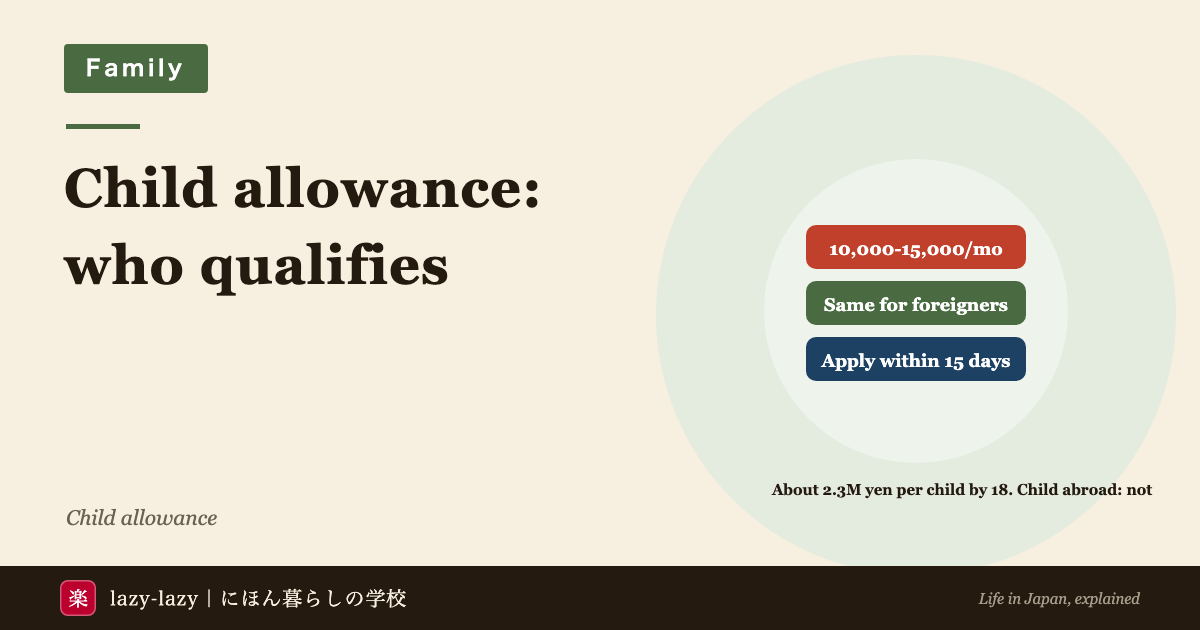
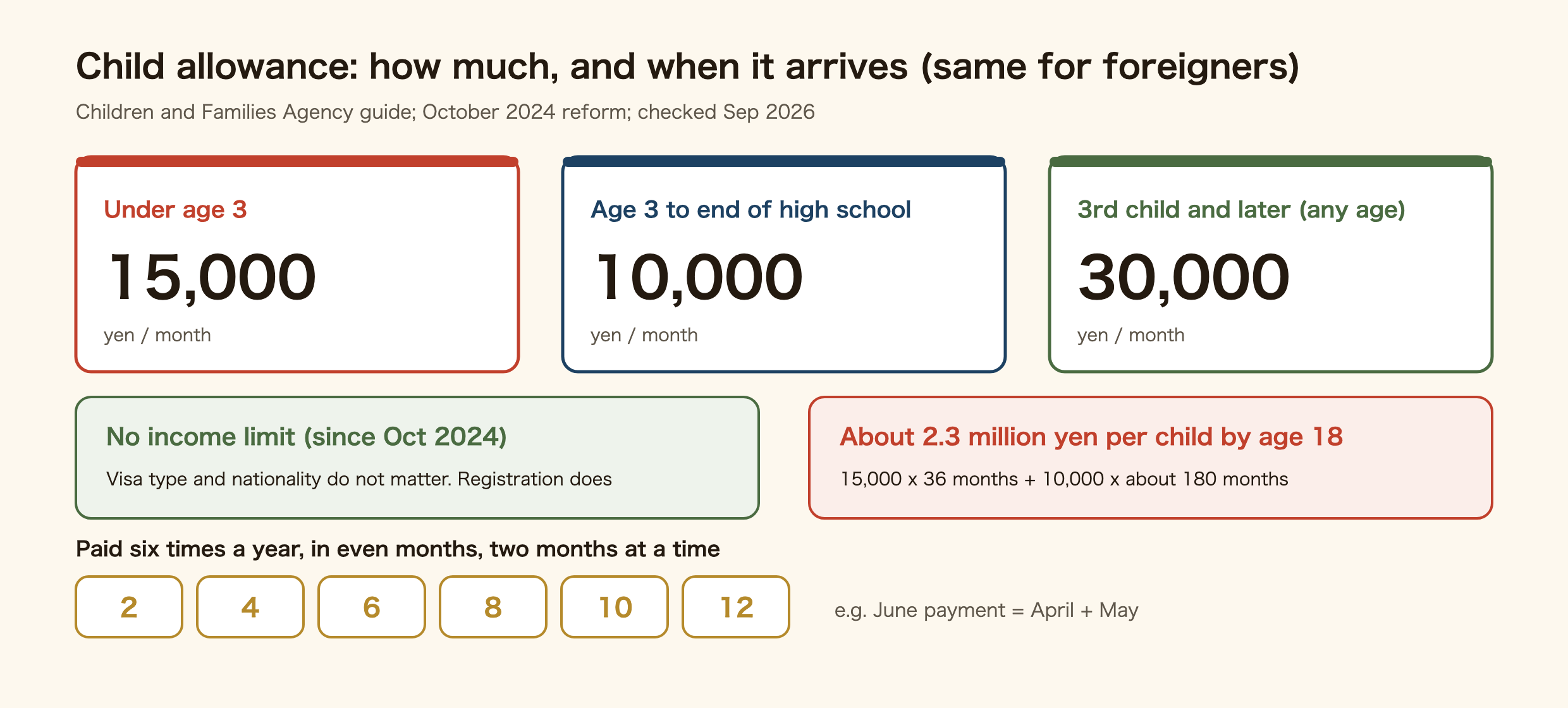
- 15,000 yen a month under age 3, 10,000 yen from 3 to the end of high school, and 30,000 yen for a third or later child. The income limit was abolished in October 2024. Over 18 years that is about 2.3 million yen per child.
- Apply at your city office. File within 15 days of the birth or of moving in and it starts from that month. File late and the months you missed are gone.
- A child living in your home country is not covered. The child must live in Japan (the only exception is study abroad, within 3 years).
- It ends the month you file a moving-out notice to leave Japan. A trip home with your resident record kept does not stop it. If your spouse stays in Japan, they re-apply and it continues.
What changes: on the day you register the birth, you walk to the next counter and apply for child allowance before you leave. The gap between “I thought foreigners could not get it” and filing within 15 days is 2.3 million yen per child.
The baby is born. You register the birth at the city office. The clerk asks, “Will you apply for child allowance?” “Can foreigners get that?” I know someone who asked exactly that. Ask a Japanese colleague and you hear “ours just arrives in the bank account.” It does not just arrive. It is paid only to people who apply, from the month after they apply.
- What is child allowance? Same for foreigners. The test is residence registration, not your visa
- How much? 10,000 to 15,000 yen a month, 30,000 for a third child. About 2.3 million yen per child by 18
- When is it paid? In even months, two months at a time
- What if my child lives in my home country? Not covered. The only exception is study abroad
- What happens when I go home, or go home for a while? It ends when the record is removed, continues when it is kept
- How to apply: the same day as the birth registration, at the next counter. The deadline is 15 days
- Missed the 15 days? File today. The past is gone, but the future is paid
- Where do you stand?
- FAQ
- Summary
- Related guides
What is child allowance? Same for foreigners. The test is residence registration, not your visa
Child allowance is a monthly payment from the national government to whoever is raising a child from birth to the first 31 March after the child’s 18th birthday (Child Allowance Act). You apply at your city office, and the city pays it into your bank account.
The legal conditions are these. The parent receiving it must have an address in Japan. And the child must have an address in Japan (Articles 3 and 4). “Having an address in Japan” means being on the resident register. Everyone who registered as a resident on a status longer than three months – Student, Technical Intern, Dependent, any work status, Spouse of Japanese National, Permanent Resident – is in. No distinction is made by visa type. Nationality is not a condition either.
The other way round: people who have not done their residence registration, and people on a short-term stay, are not covered. The one condition is the resident record.
How much? 10,000 to 15,000 yen a month, 30,000 for a third child. About 2.3 million yen per child by 18
| Child’s age | Per child, per month | Third child and later |
|---|---|---|
| Under 3 | 15,000 yen | 30,000 yen |
| 3 to the end of high school (31 March after turning 18) | 10,000 yen | 30,000 yen |
There is no income limit. It was abolished in the October 2024 reform. Until then the amount fell or stopped depending on the parents’ income; now it is the same whatever you earn. Some people still skip applying because “we both work, so we are probably over the limit” – that is old information.
Be careful with how “third child” is counted. It counts not only children up to 18 but also older brothers and sisters up to the 31 March after they turn 22, if the parents are still paying their living costs. A university-age eldest, a high-school daughter and a primary-school son: the son is the “third child” at 30,000 yen.
Add it up. One child from birth to the end of high school: 15,000 yen x 36 months + 10,000 yen x about 180 months = roughly 2.3 million yen. Two children, 4.6 million. Set that against what you send home and the size of it becomes clear.
When is it paid? In even months, two months at a time
Not monthly. Six times a year – February, April, June, August, October and December – each payment covering the previous two months. The June payment contains April and May.
So it does not feel like “10,000 yen every month” but like 20,000 yen (30,000 under age 3) landing every two months. Budget on that rhythm.
What if my child lives in my home country? Not covered. The only exception is study abroad
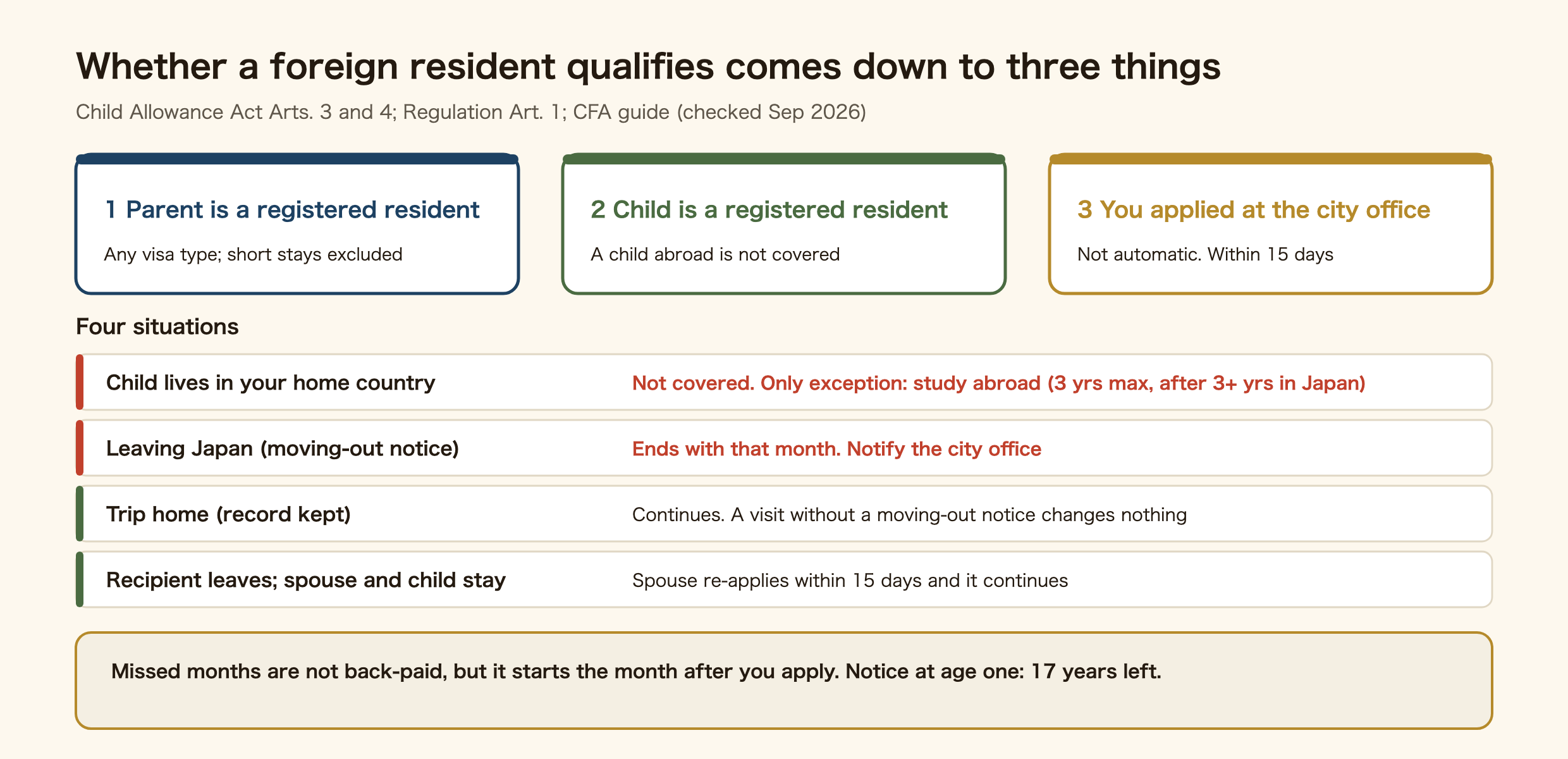
This is the part that matters most for foreign residents. The child must be living in Japan. If you work in Japan and your children are with their grandparents at home, no allowance is paid for them. The Children and Families Agency states it plainly: “in principle, paid when the child lives in Japan.”
There is one exception: study abroad. The conditions are strict – a child who lived in Japan for more than three years up to the day before leaving, living abroad for the purpose of education, within three years of leaving, and not living with a parent (Regulation Article 1). A child you left at home does not fall under it.
So when you weigh bringing your family to Japan, child allowance is a number you may put in the calculation: 120,000 to 180,000 yen a year per child, from the month after they arrive.
What happens when I go home, or go home for a while? It ends when the record is removed, continues when it is kept
The dividing line is whether you file a moving-out notice.
- Leaving Japan for good (moving-out notice filed) – the moment either the receiving parent or the child no longer has an address in Japan, the conditions fail and it ends with that month. You must notify the city office (a change of address, including moving abroad, is a notifiable event).
- A trip home (resident record kept) – a few weeks or months at home without a moving-out notice leaves your record in Japan, so it simply continues. If it is a stay of a year or more and you do file the notice, see above.
- Only the receiving parent leaves; spouse and child stay – the recipient is gone, so it stops once. The spouse who stays applies again in their own name. Within 15 days there is no gap.
- Only the child goes home – the child no longer has an address in Japan, so that child’s allowance ends.
The order of the paperwork before you leave is in the leaving-Japan checklist. The child allowance notification is done at the same counter as the moving-out notice.
How to apply: the same day as the birth registration, at the next counter. The deadline is 15 days
You apply (formally, a “claim for recognition”) at the city office where you live. Only public servants apply through their employer. Company employees and the self-employed go to the city office.
| Bring | Note |
|---|---|
| Claim form | At the counter, or on your city’s website |
| Proof of health insurance | My Number Card registered as your insurance card, or the eligibility certificate. For employees this also confirms pension enrolment |
| Bank account | In the applying parent’s name. The child’s or spouse’s account cannot be used |
| My Number | Yours and your spouse’s |
| Residence card | Usually asked for as identification |
| Child allowance income certificate | Only if you were not registered in this city on 1 January. Issued by your previous city |
The deadline is what matters. Apply within 15 days of the day after the birth, or the day after you moved into this city, and it is paid from that month. This is the “15-day rule.” Born at the end of the month, applied early the next month: still paid from the birth month if within 15 days.
Miss the 15 days and it starts from the month after you apply. And the months you missed are not paid later, however you ask. Birth registration has a 14-day deadline; child allowance 15. Doing it on the same day as the birth registration and the baby’s status of residence (30 days) is the surest way.
After that, the annual “current status report” is no longer required in principle (from June 2022). You do need to notify a move, a departure abroad, or a change of spouse. Some cities still send the report form, so do not throw away anything that arrives.
Missed the 15 days? File today. The past is gone, but the future is paid
Do not think “it has been six months, there is no point now.” The missed months are not back-paid, but from the month after you apply it is paid. Notice at age one and apply: that is 17 more years, about 2.1 million yen. There is no reason not to go.
Some cities accept the application online (you need a My Number Card). If the counter is only open on weekdays and you cannot get there, search your city’s website for “児童手当 電子申請” (child allowance online application).
Where do you stand?
- A baby was, or will be, born in Japan – apply for child allowance the same day as the birth registration. Bring a bank account in your name and your My Number Card. Within 15 days.
- You live in Japan with your child but have never applied – go to the city office this week. The past is not paid; next month is.
- Your child is in your home country – not covered for now. If you bring them, count on 10,000 to 15,000 yen a month per child from the month after they arrive.
- You have decided to leave Japan – notify child allowance at the same counter as the moving-out notice. If your spouse and child stay, the spouse re-applies within 15 days.
FAQ
Q. Can foreigners get child allowance in Japan?
Yes. Three conditions: you and your child are registered residents of Japan, and you have applied at the city office. Visa type and nationality are not conditions.
Q. How much is child allowance?
15,000 yen a month under age 3, 10,000 yen from 3 to the end of high school, 30,000 yen for a third or later child. No income limit since October 2024.
Q. Can students get it?
Yes. If you are registered as a resident on a Student status and your child lives in Japan, you qualify. Your part-time income does not matter.
Q. What if my child lives in my home country?
Not covered, in principle. The child must live in Japan. The only exception is study abroad for up to three years by a child who had lived in Japan for more than three years.
Q. Does a trip home stop it?
Not if you do not file a moving-out notice. It depends on whether your resident record stays in Japan. File the notice and leave, and it ends with that month.
Q. If I apply late, is it back-paid?
No. It starts from the month after you apply. But if you apply within 15 days of the birth or of moving in, it is paid from that month.
Q. When is it paid?
In February, April, June, August, October and December, two months at a time.
Summary
Child allowance is a national benefit foreigners receive on the same terms. The test is residence registration, not your visa. 15,000 yen a month under 3, then 10,000, and 30,000 for a third child, with no income limit. About 2.3 million yen per child by 18.
Apply at your city office within 15 days of the birth or of moving in. Missed months are not paid. A child abroad is not covered; a moving-out notice ends it; a trip home with the record kept continues. Finish it at the next counter on the day you register the birth.
Sources (official): Children and Families Agency, Guide to the Child Allowance System / CFA, the October 2024 expansion / Child Allowance Act, Articles 3 and 4 (e-Gov) / Enforcement Regulations, Article 1 (e-Gov). Amounts and procedures checked on 22 September 2026. Municipal top-ups and children’s medical subsidies differ by city; ask at the counter.
Related guides
Found this useful? Share it
Send it to a friend who lives in Japan.
WHO WROTE THIS

mori
Japanese. I read the ministries’ own notices, orders and Q&As in the original, and I start from what my Nepalese and Sri Lankan friends in Japan actually ran into. I do not write about what I have not checked or been told.
What this site can and cannot do →Looking for something else?