This article was checked on 28 October 2026 against the official pages of Rakuten Card, Sumitomo Mitsui Card and JCB on revolving payments, early repayment and missed payments, the Japan Consumer Credit Association’s revolving guide, the National Consumer Affairs Center’s warning, the Consumer Affairs Agency’s 188 hotline, Houterasu’s Multilingual Information Service and CIC’s credit information guide. The fee examples are our own calculation with Rakuten Card’s published formula. Rates and procedures differ by card and can change, so check your own card’s official page on the day.
In short
- Revolving payment (ribo-barai) means paying a roughly fixed amount of principal each month, whatever you spent, plus a fee on the remaining balance. The fee comes out of every payment, so with a small principal the balance barely moves.
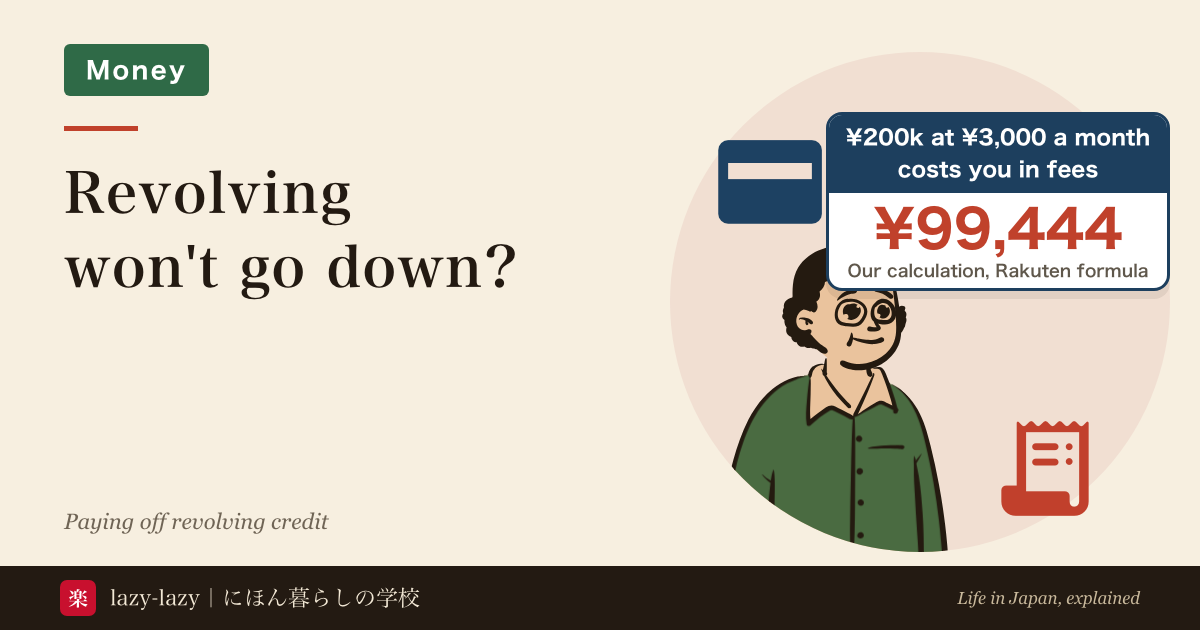
- On Rakuten Card (17.64% a year), a 200,000 yen balance on the 3,000 yen plan takes 67 payments (5 years 7 months) by our calculation, with 99,444 yen in fees. After a year of payments, the balance is down by only 36,000 yen.
- The order: stop adding to it (cancel automatic revolving), raise the monthly amount, then pay part or all of it in a lump sum. At 10,000 yen a month, the fees fall to 30,870 yen.
- With automatic revolving or a revolving-only card, purchases go on revolving even if you say “one payment” at the till. Cancelling does not remove what is already on revolving.
- If you know you cannot pay, call the card company before the due date. Payments 61+ days or 3+ months late are recorded at CIC as “ido” and stay for 5 years after the contract ends. For help, call 188 or Houterasu (0570-078377).
Knowing this, you can see how much of each payment disappears into fees, and switch this month to a way of paying that actually brings the balance down.
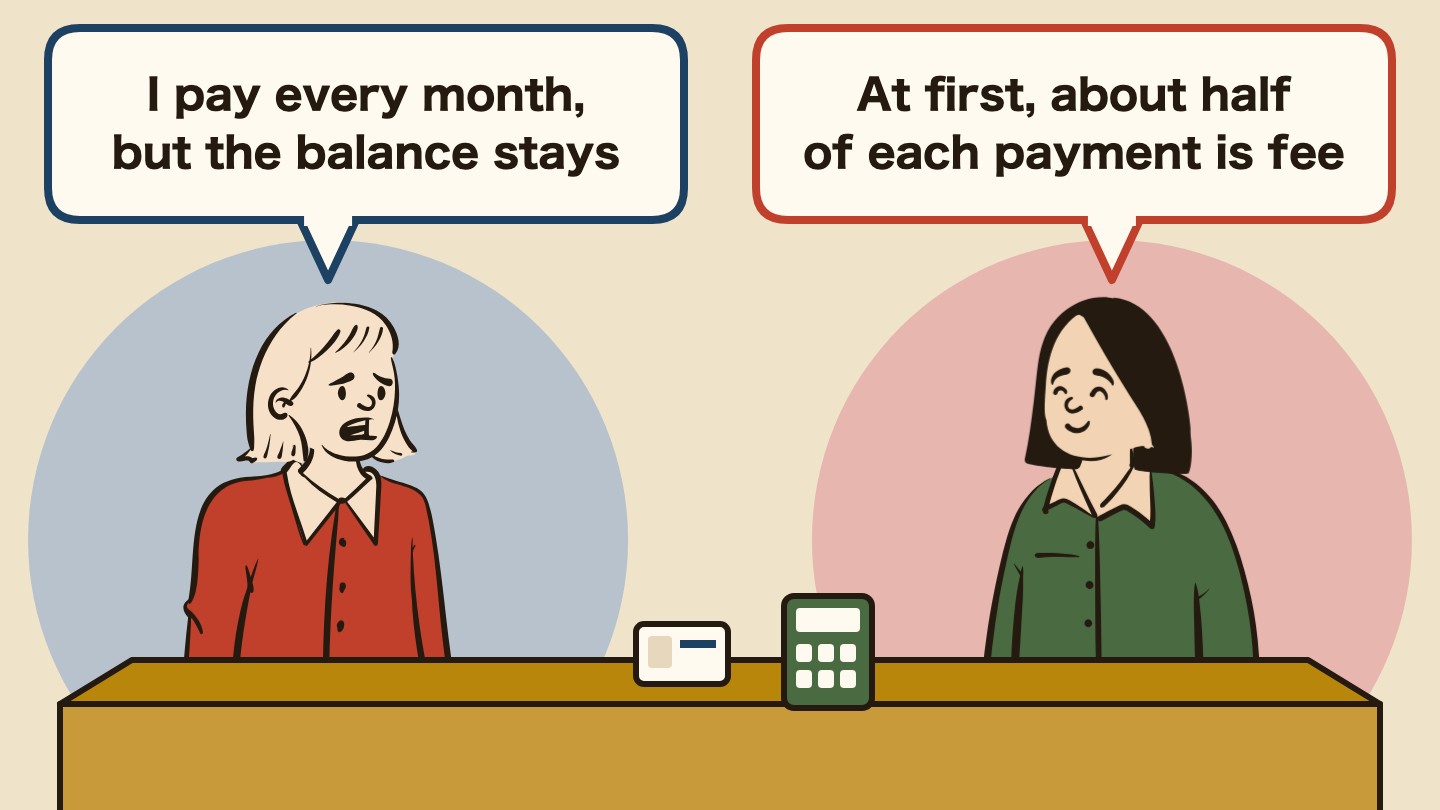
Autumn of your second year in Japan. You open your card statement and it says “revolving balance: 164,000 yen”. A year ago it was 200,000 yen. You have paid every month, a little over 5,000 yen each time. Added up, that is more than 60,000 yen. Yet the balance has not even dropped by 40,000. You show it to a Japanese colleague, who just says, “That’s how revolving works.” Where the money went is written on the statement, in the line marked “fee” (tesuryo).
- Why won’t your revolving balance go down? Half of each payment is the fee
- How does revolving payment work? Fixed amount vs balance-sliding
- How much does revolving cost? 200,000 yen at 3,000 a month means 99,444 yen in fees
- How do you stop revolving payments? Stop adding, pay more, pay it off
- How do you pay off revolving early or raise payments? Rakuten Card, Sumitomo Mitsui Card and JCB
- What are automatic revolving and revolving-only cards? “One payment” still goes on revolving
- What if you cannot pay your revolving balance? Contact the card company before you are late
- Leaving Japan with a revolving balance? Pay it off before you close your bank account
- Which one are you?
- FAQ
- Summary
- Related reading
Why won’t your revolving balance go down? Half of each payment is the fee
Each revolving payment is principal plus a fee. The fee is charged on the balance you still owe. Rakuten Card works it out as “previous month-end balance x annual rate / 12”, and its standard rate is 17.64% a year (Rakuten Card, revolving payment (Japanese)).
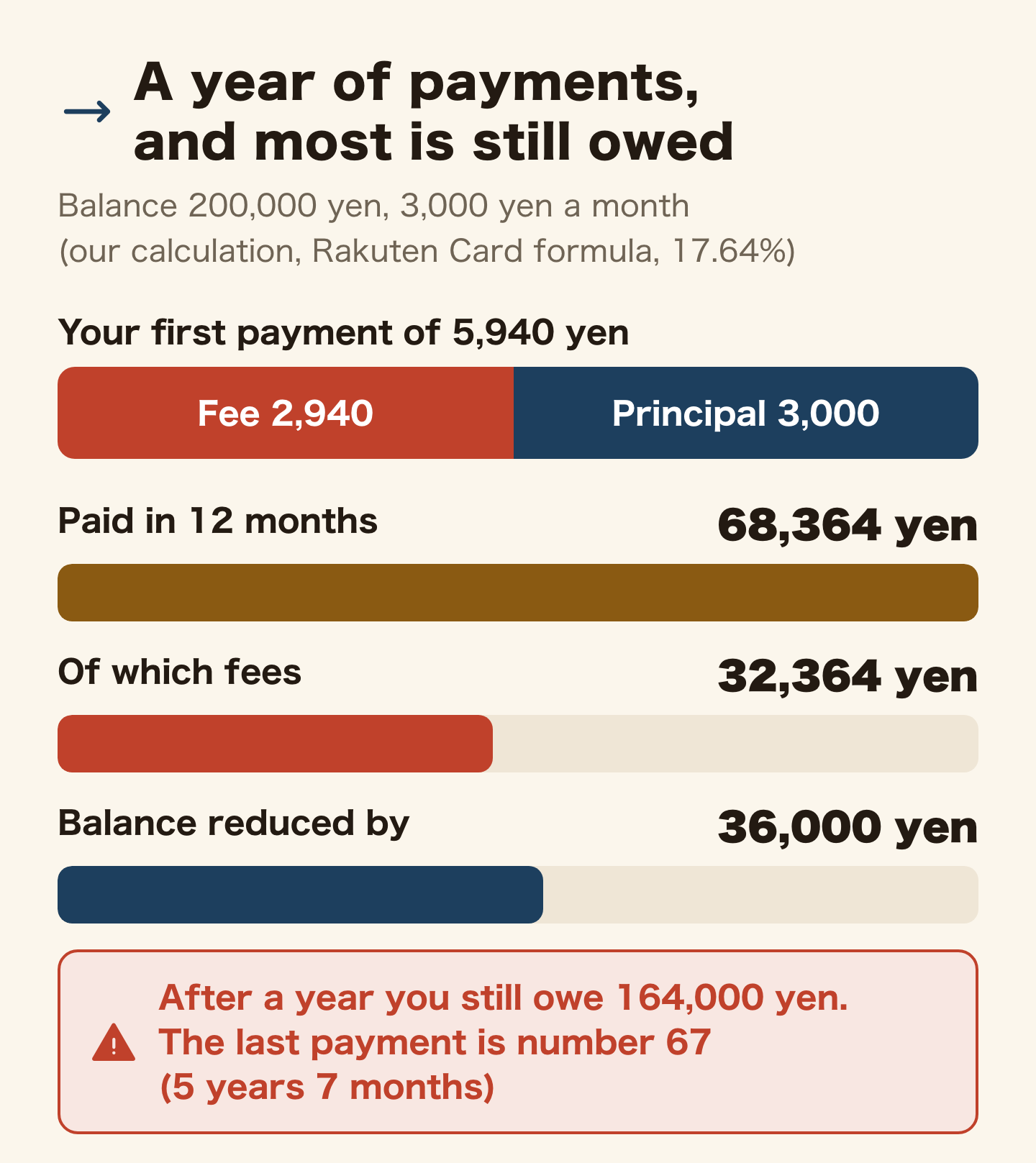
With a 200,000 yen balance, the first month’s fee is 200,000 x 17.64% / 12 = 2,940 yen. On the 3,000 yen plan, your first payment is 3,000 + 2,940 = 5,940 yen. Almost half of it is the fee. Only 3,000 yen goes to the balance.
Keep paying like this for 12 months and you have paid 68,364 yen. Of that, 32,364 yen is fees, and the balance has fallen by only 36,000 yen. You still owe 164,000 yen. Even with no new spending, the last payment is number 67, five years and seven months away. The balance stays high not because you are not trying hard enough, but because the fee is built into every payment.
We calculated this with Rakuten Card’s formula, rounding each month’s fee down to the yen and assuming no new spending. The same method gives exactly the figures in Rakuten Card’s own published example (150,000 yen on the 10,000 yen plan: 15 payments, 17,640 yen in fees) (Rakuten Card, changing your revolving payment (Japanese)). Real fees differ slightly because they are counted by the day from when you use the card. To try your own balance, use Rakuten Card’s shopping revolving calculator (Japanese).
How does revolving payment work? Fixed amount vs balance-sliding
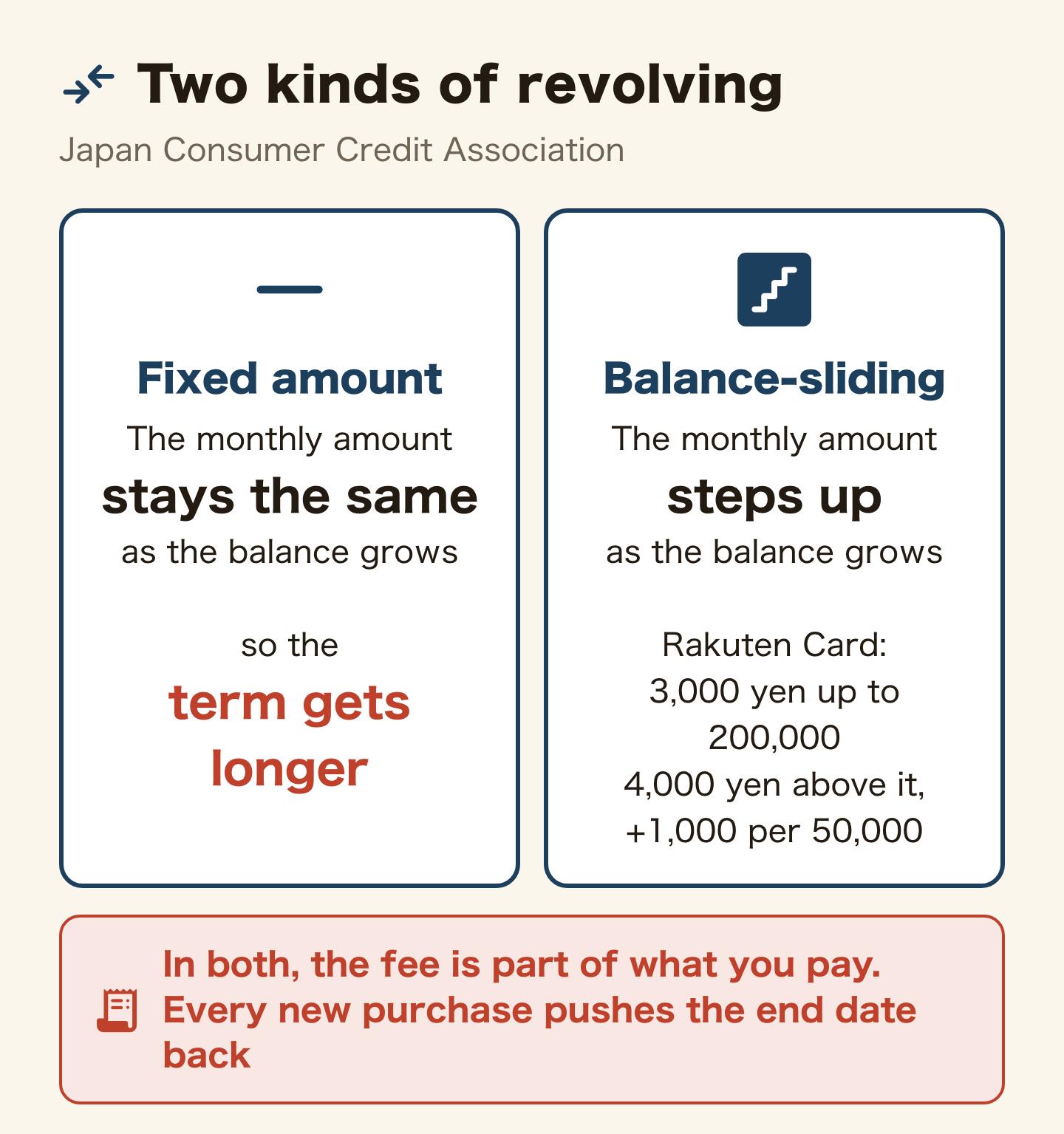
The Japan Consumer Credit Association describes two ways revolving payments are set (Japan Consumer Credit Association, revolving payment features and cautions (Japanese)).
- Fixed amount: the monthly payment stays the same even as the balance grows. The term gets longer instead.
- Balance-sliding: the monthly payment steps up as the balance grows.
Rakuten Card uses balance-sliding. On the 3,000 yen plan, the principal is 3,000 yen up to a 200,000 yen balance and 4,000 yen above it. After that it rises by 1,000 yen for every extra 50,000 yen. Whatever the method, the fee is part of every monthly payment.
The same association’s Q&A says you cannot choose the length of a revolving plan. Each new purchase is added to the balance and pushes the end date back. Unlike instalments, there is no fixed number of payments.
How much does revolving cost? 200,000 yen at 3,000 a month means 99,444 yen in fees
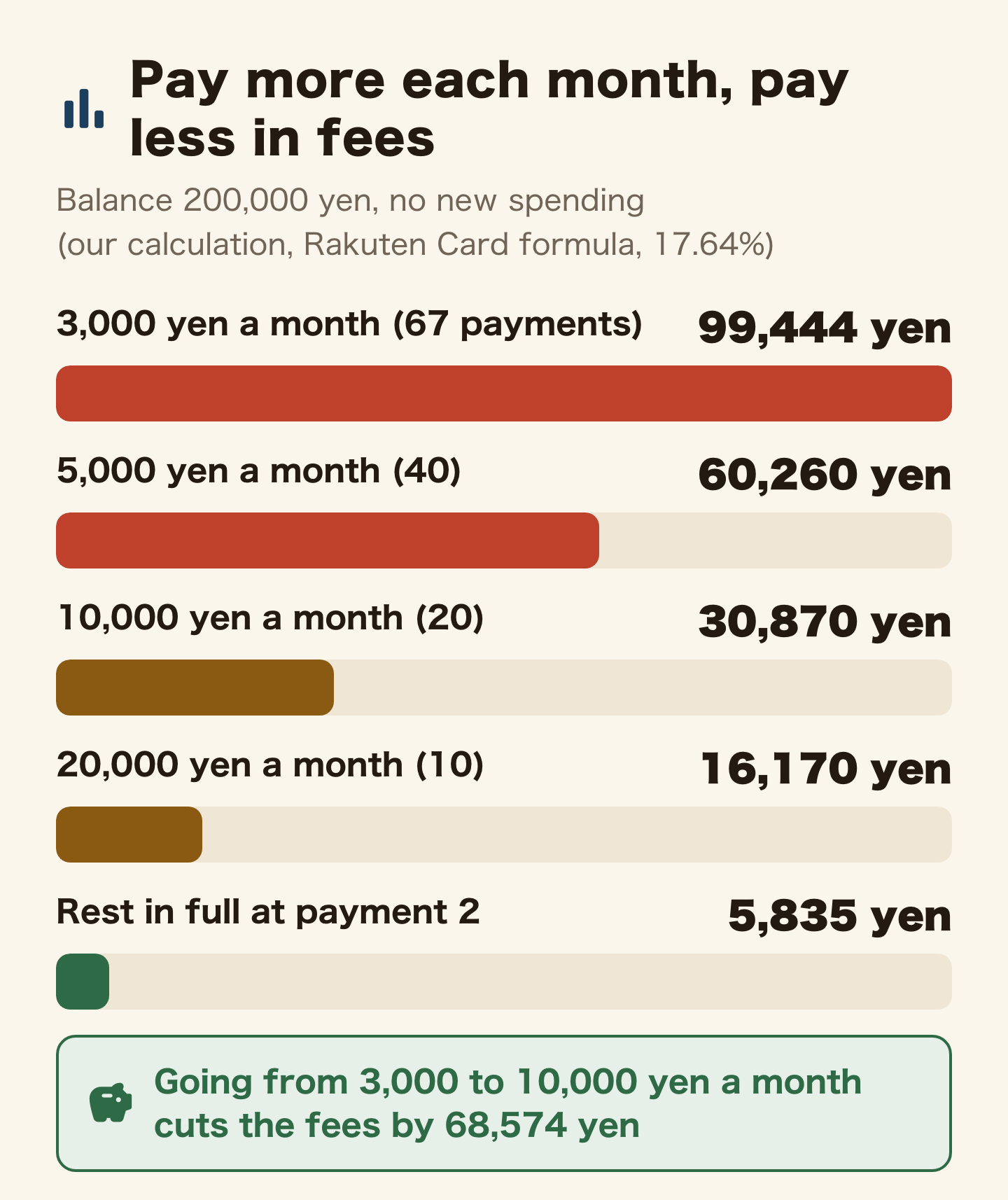
For the same 200,000 yen, the monthly amount changes the total fee a great deal. We used Rakuten Card’s formula with no new spending.
| Monthly principal | Payments | Total fees | Total paid |
|---|---|---|---|
| 3,000 yen | 67 | 99,444 yen | 299,444 yen |
| 5,000 yen | 40 | 60,260 yen | 260,260 yen |
| 10,000 yen | 20 | 30,870 yen | 230,870 yen |
| 20,000 yen | 10 | 16,170 yen | 216,170 yen |
| Rest in full at payment 2 | 2 | 5,835 yen | 205,835 yen |
Raise the monthly amount from 3,000 to 10,000 yen and the fees fall by 99,444 − 30,870 = 68,574 yen. Pay the remaining 197,000 yen in full with the second payment and the fees stop at 2,940 + 2,895 = 5,835 yen. Rakuten Card itself says a higher plan shortens the term and keeps the fees down.
To see just how heavy 17.64% a year is, don’t borrow money in Japan (revolving at 17.64% compared with Warren Buffett’s record) puts the numbers side by side.
How do you stop revolving payments? Stop adding, pay more, pay it off
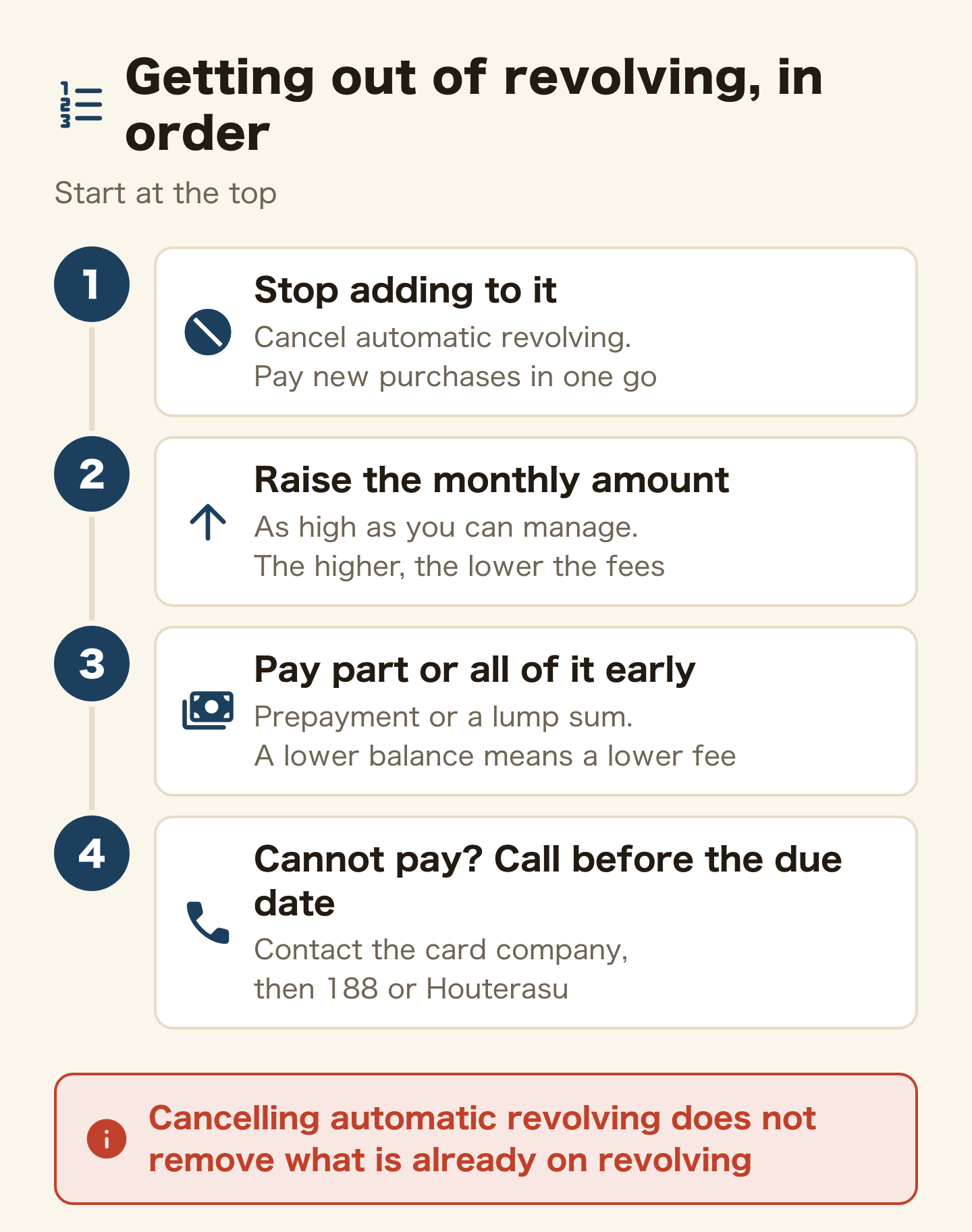
Work through these from the top. If you keep spending on revolving, whatever you pay off early is simply added back.
- Stop adding to it. If you signed up for automatic revolving, cancel it. Rakuten Card’s automatic revolving can be cancelled on Rakuten e-NAVI at any time, 24 hours a day (Rakuten Card, automatic revolving (Japanese)).
- Raise the monthly amount. Rakuten Card lets you raise your revolving plan in steps of 1,000 yen. You can change it once a day, and the cut-off for that month is 10 p.m. on the 10th of the payment month.
- Pay part or all of it in a lump sum. After payday or in a bonus month, pay off part or all of the balance at once.
- If you know you cannot pay, contact the card company before the due date. Before you fall behind, not after.
One thing to know about cancelling. Rakuten Card says purchases that were automatically put on revolving cannot be switched back to their original payment method. Cancelling only stops future purchases. Cancelling is not the end: the balance that remains still has to come down through steps 2 and 3.
Rakuten Card itself warns that with automatic revolving, the balance can grow without you noticing and the repayment period can stretch out. Pay for new things in one payment on the card, or with a debit card or another way you can pay that month. How to use a card on one-off payments only is covered in credit cards for foreigners in Japan (check this before you apply).
How do you pay off revolving early or raise payments? Rakuten Card, Sumitomo Mitsui Card and JCB
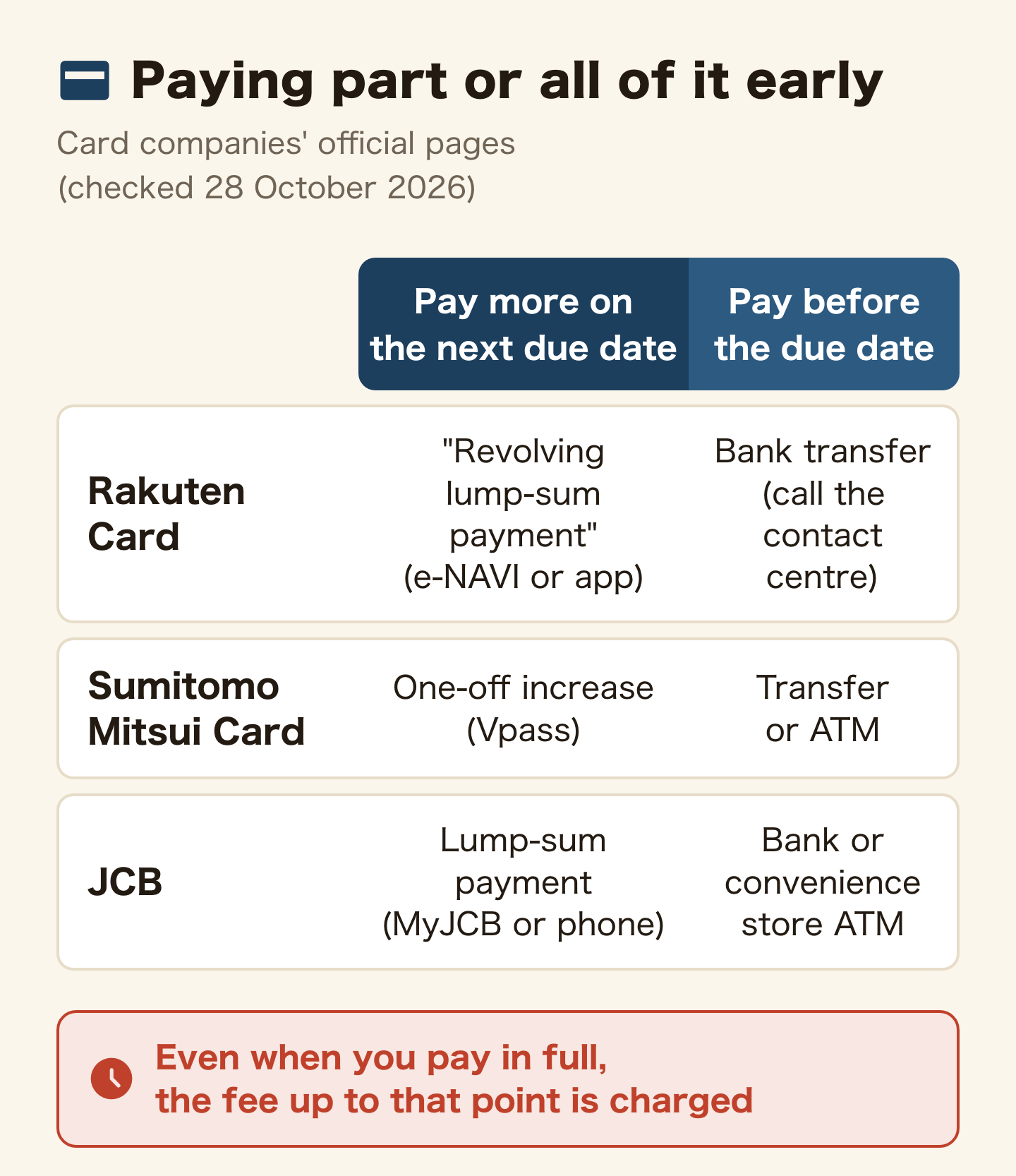
Every card company has a way to bring the balance down faster. The Japan Consumer Credit Association also says you can pay part or all of the balance to shorten the term and save on fees. The method differs by company.
- Rakuten Card: with “revolving lump-sum payment” (ribo zandaka no omatome-barai), you add part or all of the balance to your next payment. Apply on Rakuten e-NAVI or the Rakuten Card app. If you apply by 10 p.m. on the 10th of the payment month, it is added to that month’s payment. To pay by bank transfer instead, call the contact centre (Rakuten Card, changing your revolving payment (Japanese)).
- Sumitomo Mitsui Card: on Vpass you can make a one-off increase to your next payment. You can also pay part or all of the balance by transfer to the company’s account, or at partner bank and convenience store ATMs. There is no ATM fee (Sumitomo Mitsui Card, extra revolving payments (Japanese)).
- JCB: before the payment date (the 10th of each month), you can pay in at a bank or convenience store ATM. Set it on MyJCB or by phone (automated) and part or all of the balance is added to your payment on the 10th (JCB, lump-sum early repayment (Japanese)). Paying at an ATM costs an ATM fee of 110 yen for 10,000 yen or less per payment, or 220 yen above that (some card issuers cover it). Revolving-only cards cannot make lump-sum payments at an ATM.
Even in the month you pay in full, the fee up to that point is charged. Rakuten Card says the fee applies even when you choose to pay the whole balance. At Sumitomo Mitsui Card, a full one-off increase is still charged fees up to the payment date. At JCB, an ATM payment covers principal only, and the fee, counted daily up to the day you pay in, is debited on the 10th.
Rates differ by card too. Sumitomo Mitsui Card’s revolving rate for new members is 18.0% a year (15.0% for cards joined or given a revolving limit on or before 30 March 2026). After joining, the rate may be lowered to as little as 9.8% if you meet the company’s conditions, but this can be withdrawn, and rates also differ by card type (Sumitomo Mitsui Card, revolving payment (Japanese)). For other cards, look on your statement or the card company’s official page for “kuriage hensai” (early repayment) or “matome-barai” (lump-sum payment). Rakuten Card also has an English FAQ (Rakuten Card, FAQ (English)).
What are automatic revolving and revolving-only cards? “One payment” still goes on revolving
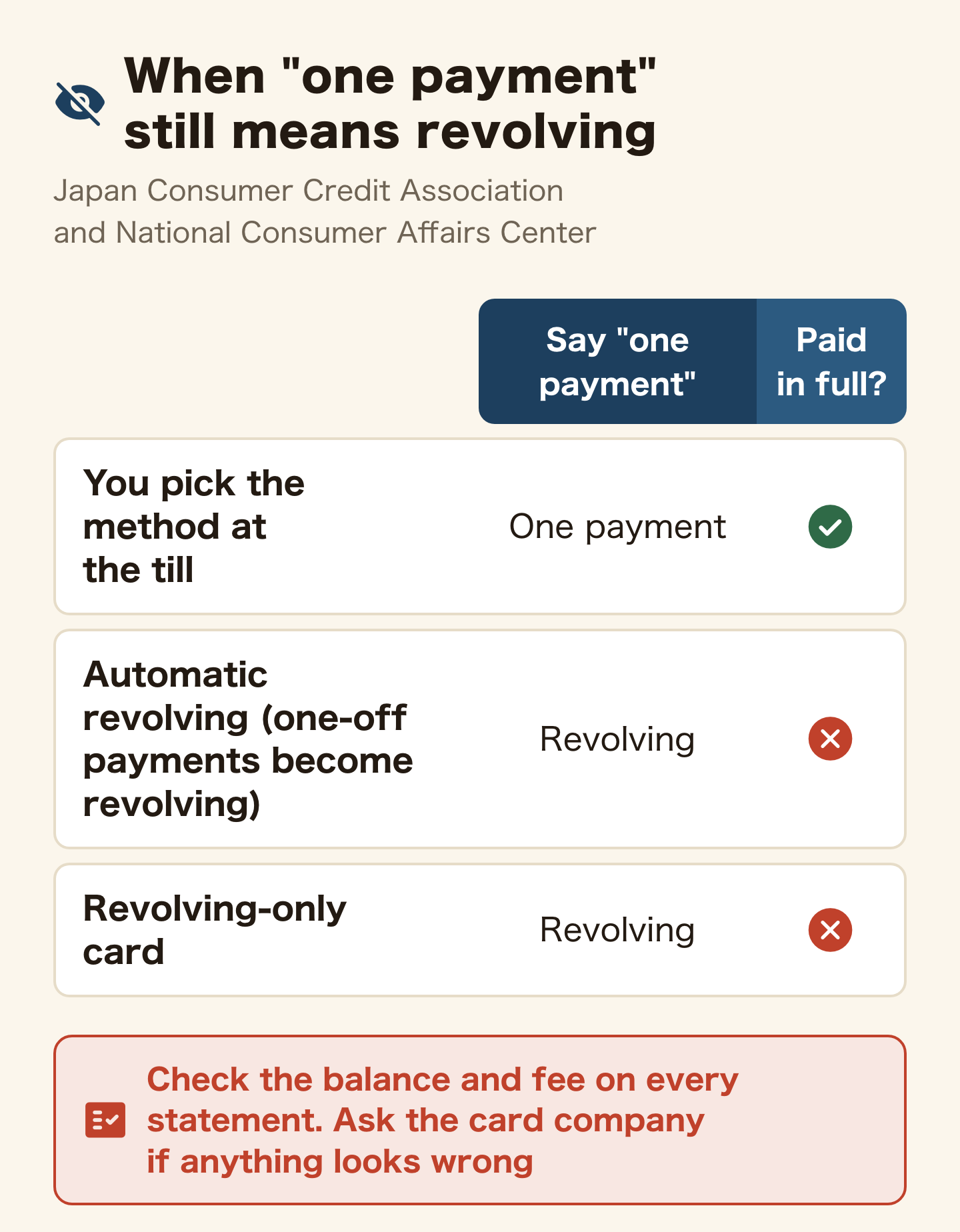
There is more than one way to end up on revolving. The Japan Consumer Credit Association lists three.
- Cards where you can choose revolving among the payment options when you pay
- Cards limited to revolving from the start (revolving-only cards)
- Cards where, once you register, one-off payments automatically become revolving (automatic revolving)
The National Consumer Affairs Center warns that with a revolving-only card or automatic revolving, purchases go on revolving even if you say “one payment in full” at the till (National Consumer Affairs Center, unintended revolving payments (Japanese)). The same page describes a consumer who did not remember choosing revolving, but had been on it since applying and owed 180,000 yen.
Your monthly statement is how you tell. Look at the revolving balance and fee lines. If anything is unclear, ask the card company straight away. Some plans, like Sumitomo Mitsui Card’s “My Pay-su Ribo”, carry over anything above the amount you set to the following months (Sumitomo Mitsui Card, My Pay-su Ribo (Japanese)).
What if you cannot pay your revolving balance? Contact the card company before you are late
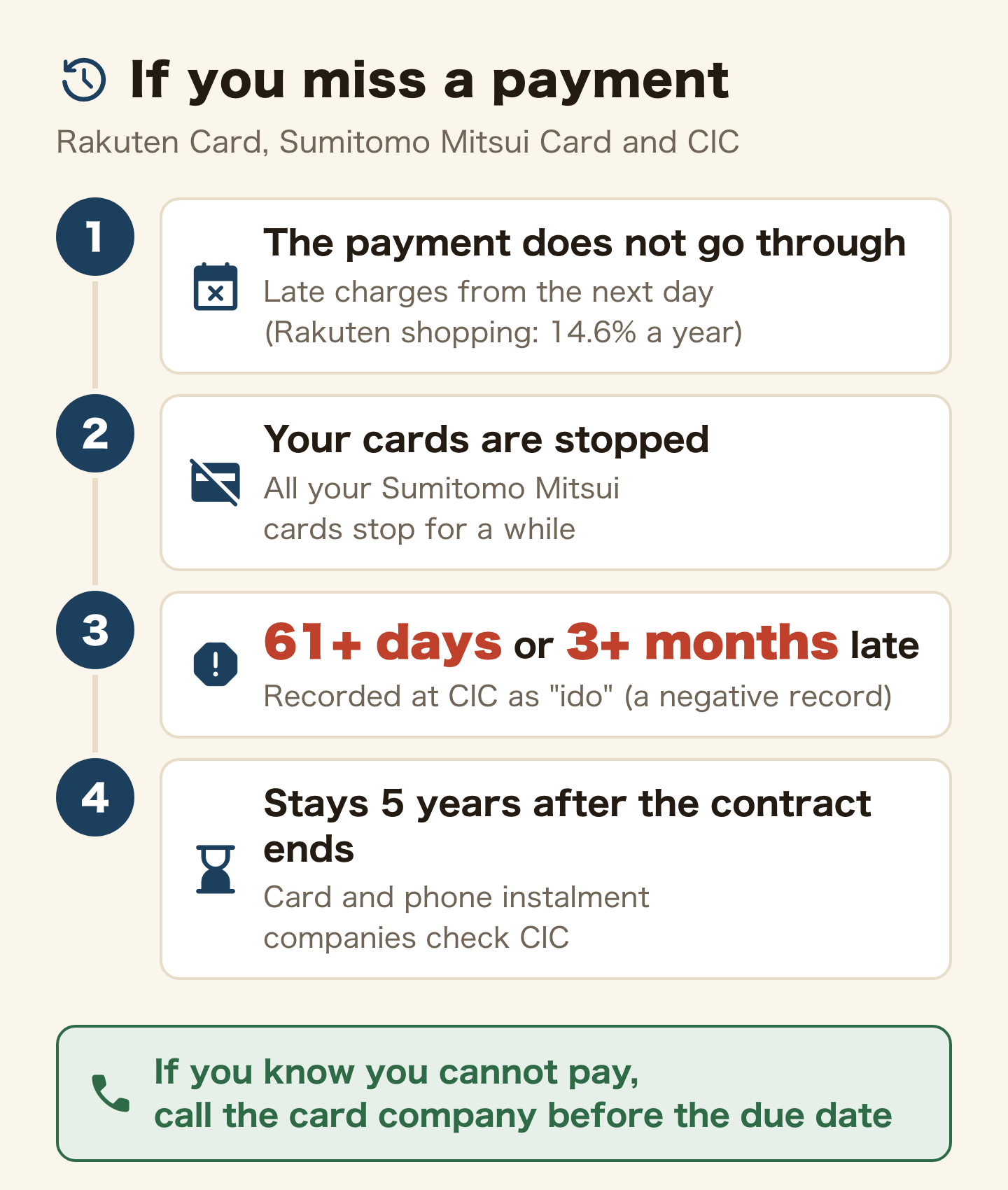
A few days late, paid later, no problem. Where you come from, that may be normal. In Japan, late charges start the day after the due date, and your card is stopped.
- Late charges: at Rakuten Card, from the day after the due date until you pay, late charges run at 14.6% a year on shopping and 20% a year on cash advances. If you have not paid by the due date, a 275 yen collection fee is added too (Rakuten Card FAQ, if your payment could not be debited (Japanese)).
- Cards stopped: at Sumitomo Mitsui Card, until you pay, all the cards you hold are suspended for a while (Sumitomo Mitsui Card, if your payment could not be debited (Japanese)).
- Credit record: a payment 61+ days or 3+ months late is recorded at CIC as “ido” (CIC glossary (Japanese)). Your payment history, including any ido, is kept while the contract runs and for 5 years after it ends (CIC, how long credit information is kept (Japanese)).
That record is read when you next apply. CIC explains that card companies and mobile phone companies check CIC’s credit information when you apply for a card or buy a phone on instalments. Late or unpaid records may affect the decision (CIC, for first-time visitors (Japanese)). How the phone instalment check works is in buying a phone on instalments in Japan as a foreigner. You can see your own record through CIC’s online disclosure (500 yen) (CIC, disclosure (Japanese)).
The moment you know you cannot pay, call the card company, before the due date. Fall behind without a word and the late charges and the credit record begin. If it is hard to talk to the card company, or other bills are piling up too, these services can help.
- Consumer Hotline 188: puts you through to a nearby consumer affairs centre or consultation desk (Consumer Affairs Agency, Consumer Hotline (Japanese)).
- Houterasu Multilingual Information Service: 0570-078377 (from an IP phone or prepaid mobile, 050-3754-5430), weekdays 9 a.m. to 5 p.m. In a three-way call with an interpreter, staff explain the system and where to get help. The service is free; you pay the call charge (Houterasu, Multilingual Information Service). If you cannot afford it, free legal consultation with a lawyer is also available.
Short of money, you may be tempted to borrow somewhere else to pay off the revolving. That adds a second set of fees or interest. Ways to split or delay rent, tax or tuition in a tight month are set out in order in don’t borrow money in Japan.
Leaving Japan with a revolving balance? Pay it off before you close your bank account
Once you decide to leave, you also start closing your Japanese bank account. Your card payments come out of that account. Rakuten Card says you cannot use revolving lump-sum payment unless your debit account registration is complete.
If you have a revolving balance, pay it all off before you close the account. A CIC record stays for 5 years after the contract ends. If it shows late payments, card and phone instalment checks may see it if you come back to live in Japan. Once it is paid, check your statement to confirm the balance is 0 yen.
Which one are you?
- You can pay the whole balance from savings now: pay it off in one go. Today, check the cut-off for lump-sum or early repayment on your card’s member site, and apply.
- You cannot pay it all, but you can pay more each month: raise your plan. Today, decide how much your budget can spare each month, and change your plan to that amount.
- You do not know why you are on revolving: check for automatic revolving or a revolving-only card. Today, look at the revolving balance and fee lines on your statement, then cancel automatic revolving or ask the card company.
- You cannot make this month’s payment: call before you are late. Today, ring the number on the back of your card and tell them when and how much you can pay.
- You are already late: ask how to pay right away. Today, follow the card company’s instructions to pay, and if other bills are piling up too, call 188 or Houterasu (0570-078377).
Once you have stopped adding to revolving and started paying an amount that brings the balance down every month, this decision is done. From then on, watch the balance fall on each statement.
FAQ
Q. Why won’t my revolving balance go down?
Because each payment includes a fee on the remaining balance. On Rakuten Card (17.64% a year), with a 200,000 yen balance on the 3,000 yen plan, 2,940 yen of your first 5,940 yen payment is the fee. New spending makes the balance even slower to fall.
Q. How much in fees does it cost to pay off 200,000 yen on revolving?
By our calculation with Rakuten Card’s formula, 99,444 yen over 67 payments at 3,000 yen a month. At 10,000 yen a month it is 30,870 yen over 20 payments, and paying the rest in full at the second payment costs 5,835 yen. Real amounts differ slightly because fees are counted by the day, so check with your card company’s calculator.
Q. If I cancel automatic revolving, is the revolving over?
No. Cancelling only stops future purchases. Rakuten Card says purchases automatically put on revolving cannot be switched back to their original payment method. Bring the remaining balance down by raising your payments or paying a lump sum.
Q. Is there a fee if I pay off revolving in full?
The fee up to the month you pay is charged. At Rakuten Card the fee applies even when you choose to pay in full, at Sumitomo Mitsui Card it runs up to the payment date, and JCB ATM payments are charged daily up to the day you pay in. The sooner you pay, the fewer fees after that.
Q. What happens if I cannot pay my revolving balance?
At Rakuten Card, late charges of 14.6% a year on shopping start the day after the due date. If you are 61+ days or 3+ months late, CIC records it as ido, and it stays for 5 years after the contract ends. If you know you cannot pay, contact the card company before the due date.
Q. Where can I get help with revolving debt?
Start with the card company. If that is hard, or other bills are piling up too, call Consumer Hotline 188 or Houterasu’s Multilingual Information Service (0570-078377, weekdays 9 a.m. to 5 p.m.).
Summary
Your revolving balance won’t go down because every payment includes a fee. On Rakuten Card (17.64% a year), paying off a 200,000 yen balance at 3,000 yen a month takes 67 payments by our calculation, with 99,444 yen in fees. After a year, the balance is down by only 36,000 yen. At 10,000 yen a month, the fees fall to 30,870 yen.
The order is: stop adding to revolving, raise the monthly amount, and pay part or all of it in a lump sum. Cancelling automatic revolving does not remove what is already on revolving. If you know you cannot pay, contact the card company before the due date. Payments 61+ days or 3+ months late leave a CIC record for 5 years after the contract ends. For help, call 188 or Houterasu.
Official sources: Rakuten Card revolving payment, automatic revolving, changing your revolving payment, shopping revolving calculator, if your payment could not be debited, FAQ (English); Sumitomo Mitsui Card revolving payment, extra revolving payments, My Pay-su Ribo, if your payment could not be debited; JCB, lump-sum early repayment; Japan Consumer Credit Association, revolving payment features and cautions; National Consumer Affairs Center, unintended revolving payments; Consumer Affairs Agency, Consumer Hotline; Houterasu For Foreign Nationals, Multilingual Information Service; CIC glossary, how long credit information is kept, for first-time visitors, disclosure (all checked 28 October 2026). The fee examples are our own calculation with Rakuten Card’s published formula. Rates and procedures change, so check the official page on the day.
Related reading
Found this useful? Share it
Send it to a friend who lives in Japan.
WHO WROTE THIS

mori
Japanese. I read the ministries’ own notices, orders and Q&As in the original, and I start from what my Nepalese and Sri Lankan friends in Japan actually ran into. I do not write about what I have not checked or been told.
What this site can and cannot do →Looking for something else?
You may use the figures in this article, including commercially, if you credit this site with a link. How to use our figures