Checked on 24 November 2026 against official pages: the Library Act, the education ministry’s standards for public libraries, the user guides and FAQs of Shinjuku City Library, Yokohama City Library and Osaka Municipal Library, Osaka’s self-study list (updated 18 August 2026), and the Immigration Services Agency’s page on the residence card. The 3 libraries are examples. Check the rules at your own local library.
The short answer
- A library card (toshokan kado) lets you borrow books from a city or ward public library. Getting one is free, and so is borrowing.
- In Shinjuku, Yokohama and Osaka, people who live in the city can get one. So can people who work or study there.
- Bring ID that shows your name and current address. Shinjuku names the residence card. Elsewhere, ask at the counter.
- In the 3 examples you can borrow 10 to 15 items for about 2 weeks. When the library is closed, use the return box.
- Studying with only your own books (jishu) follows each library’s own rule. Some libraries do not allow it.
Knowing this, sign up at a nearby library this week, and Japanese books and newspapers are free.
On your way home from school, you pass a big library. Inside, people read newspapers quietly. You see books with lots of pictures. They look good for Japanese practice. You want to borrow some. You ask a Japanese friend. “I guess you need a resident record?” Nobody knows if foreigners can get a card, or what to bring.
- What is a library card in Japan? A free card for public libraries
- Can foreigners get a library card in Japan? Yes, where you live, work or study
- How to get a library card in Japan: what to bring, 5 steps
- How many books can you borrow, for how long? 10 to 15, about 2 weeks
- How do you return books? Any branch, or the return box
- Can you reserve books online? Yes, with a password
- Can you study at a public library in Japan? Each library has its own rule
- What helps you learn Japanese? Easy Japanese, your language, newspapers
- What if you return books late? Borrowing stops, lost books are replaced with the same book
- Can’t make the due date, or can’t go in?
- Which one are you?
- FAQ
- Summary
- Related reading
What is a library card in Japan? A free card for public libraries
A library card lets you borrow books from a public library run by your city or ward. Shinjuku calls it a “user card” (riyosha kado). The name differs, but it does the same job.
Public libraries in Japan may not charge for entry or for using their materials (Library Act, Article 17). Making a card is free. Borrowing is free. Copies cost extra: in Osaka, 10 yen per black-and-white page (Osaka: how to use the library).
You do not need a card just to go in and read. Yokohama’s easy-Japanese guide says anyone can enter the library (Yokohama City Library guide in easy Japanese). You need the card to take books home, and to reserve them.
Can foreigners get a library card in Japan? Yes, where you live, work or study
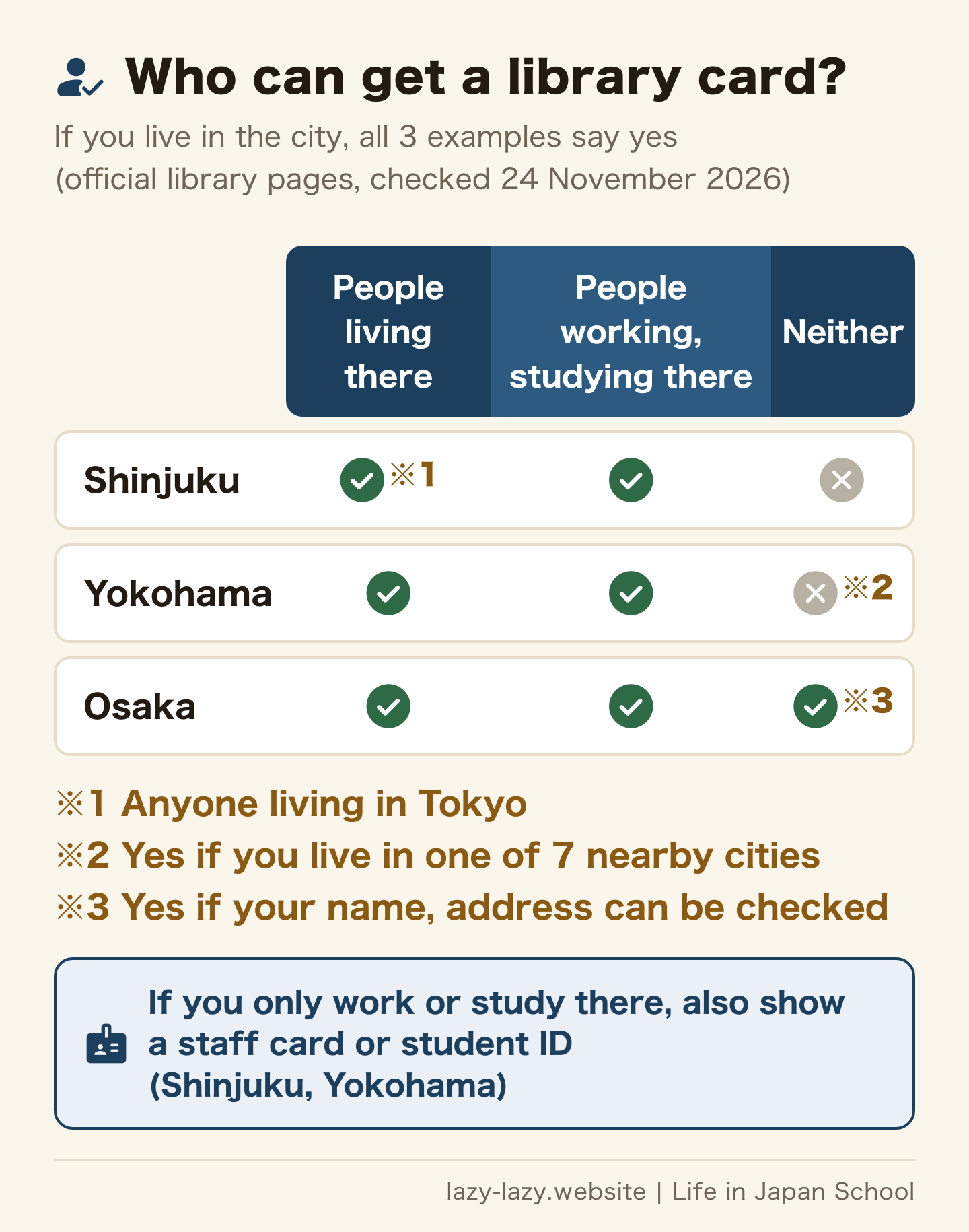
None of the 3 library guides set a nationality rule. What matters is where you live, work or study. The rules differ by city, so here are the 3 examples.
- Shinjuku: anyone who lives in Tokyo can get one. People from outside Tokyo who work or study in the ward can too. Others cannot (Shinjuku City Library: registration, borrowing, returning).
- Yokohama: people who live, work or study in the city. Residents of 7 nearby cities, such as Kamakura and Kawasaki, also qualify (Yokohama: registration for first-time borrowers).
- Osaka: people who live, work or study in the city can get one. Even if you do not live there, you can apply yourself if your name and current address can be checked (Osaka Municipal Library FAQ).
A language school student may also get a card in the city where the school is. Shinjuku and Yokohama both accept people who study there. If your home and school are in different cities, ask at both.
One card works at every library in that city or ward. An Osaka city card does not work at Osaka prefectural libraries. Start with one card from the library you will use most.
How to get a library card in Japan: what to bring, 5 steps
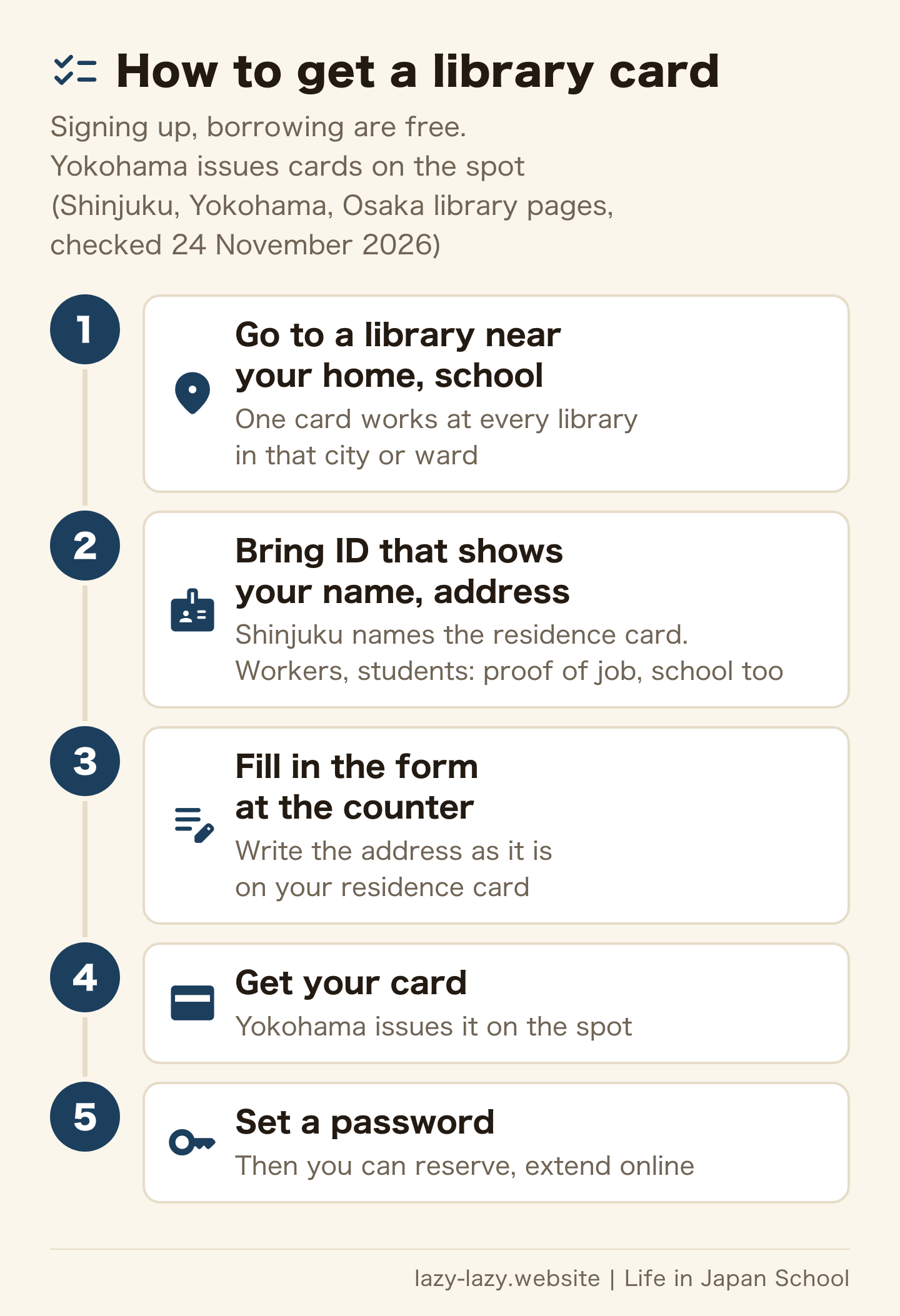
First, search “(your city or ward name) library”. Open the page for new users (often called riyo toroku or hajimete no kata e). Check the opening hours and closed days there too.
The address check is where people get stuck. Yokohama’s guide warns about it: bring originals (the real document, not a copy), and old papers may not count.
What to bring: ID with your name and current address
In every example, you show something with your name and current address. Each city lists different examples.
- Shinjuku: an official document proving your address, such as a driving licence or residence card.
- Yokohama: a driving licence, My Number Card, resident record copy or student ID. Originals only. A resident record copy must be under 3 months old.
- Osaka: a My Number Card, driving licence, student ID and so on (Osaka Municipal Library: using the library in person).
Yokohama and Osaka do not name the residence card in their lists. But your residence card shows your address (Immigration Services Agency: what is a residence card?). At the counter, ask: “Is my residence card OK?” Bring your student ID too, just in case.
Foreign residents must carry the residence card at all times. The rule, and what happens if you forget it, are in do I have to carry my residence card?
If you only work or study there, bring one more thing
If you do not live in that city, also show proof of your job or school. In Shinjuku, if your student ID has no address, you need a certificate of enrolment. Shinjuku and Yokohama both say business cards are not accepted.
The steps: fill in a form at the counter
- Go to a library near your home or school. Shinjuku says you must go in person.
- At the counter, get the form. Write your name, address and phone number.
- Write the address exactly as it is on your residence card. If the block numbers confuse you, see how to write a Japanese address.
- Show your ID and get your card. Yokohama issues it on the spot.
- To use the library online, set a password. You need it to reserve and to extend.
Yokohama also takes applications online. Applying by post is only for city residents whose resident record shows their current address. Osaka residents can apply by post too. If the counter feels hard, these are options.
Cards expire. Osaka’s last 3 years, Yokohama’s 5 years. Every 3 years, Shinjuku checks at the counter that you still meet its address, work or school rules. Bring ID with your address then too.
How many books can you borrow, for how long? 10 to 15, about 2 weeks
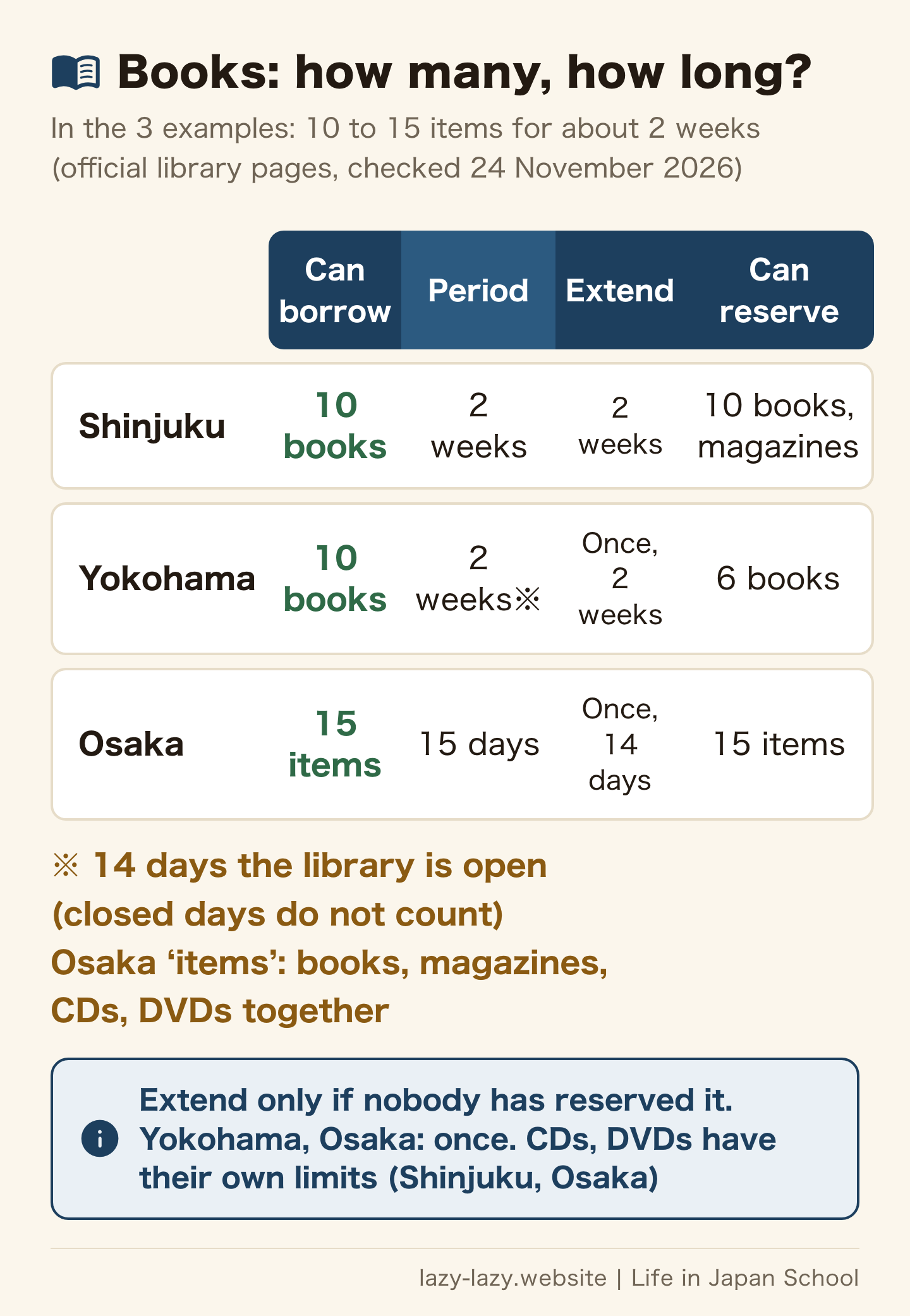
The limits differ by city.
- Shinjuku: up to 10 books and magazines for 2 weeks. On top of that, 5 CDs and 2 DVDs.
- Yokohama: up to 10 books across all libraries, for 2 weeks. Closed days do not count: it is 14 days the library is open (Yokohama: borrowing, returning).
- Osaka: up to 15 items across all libraries, for 15 days. Up to 5 of them can be DVDs or CDs.
In Osaka, ‘items’ means books, magazines, CDs, DVDs and so on, counted together. In Osaka, if you borrow 5 DVDs, you can take up to 10 books (Osaka: how to use the library).
Not finished? You can extend. In all 3 examples, nobody else may have reserved the book.
- Shinjuku: books get 2 more weeks. No limit on the number of times is stated. CDs and DVDs cannot be extended.
- Yokohama: once only. Do it before the due date and you get 2 more weeks. After the due date, the days you are late are taken off.
- Osaka: once only, for 14 days.
To borrow, take your card and the books to the counter. Shinjuku also has self-checkout machines. In Yokohama, you cannot borrow without your card.
How do you return books? Any branch, or the return box
You can return books to any library in the same city or ward. Borrow near school, return near home.
When the library is closed, use the return box (henkyaku posuto) at the entrance. Shinjuku calls it the “book post”. Shinjuku does not accept CDs or DVDs in the box, because they can break (Shinjuku City Library guide). Osaka says no CDs, and DVDs must be wrapped (Osaka Municipal Library FAQ). Take CDs to the counter during opening hours.
Yokohama processes books from the box the next morning it opens. Until then, they still show as borrowed. Over the New Year closure, Yokohama’s return boxes cannot be used (Yokohama lending guide). Osaka also asks you not to use them then (Osaka Municipal Library FAQ).
Can you reserve books online? Yes, with a password
If someone else has the book, you can reserve it and wait your turn. You can also have a book sent from another branch to your nearest one.
- Shinjuku: up to 10 books and magazines. Reserve online, by phone, on the in-library terminal or at the counter (Shinjuku City Library: reservations).
- Yokohama: up to 6 books. Only people who live in the city, plus those who work or study there, can reserve.
- Osaka: up to 15 items (up to 5 DVDs or CDs). Online reservations need your card number plus password.
When the book is ready, you get an email or a call. In Shinjuku, you have 7 days from the next day to pick it up, not counting closed days. After that, the reservation is cancelled.
Residents sometimes get more options. Since 1 October 2025, Shinjuku lets only people who live, work or study in the ward reserve books that arrived about a month ago or less. After that month, anyone can reserve them.
Can you study at a public library in Japan? Each library has its own rule
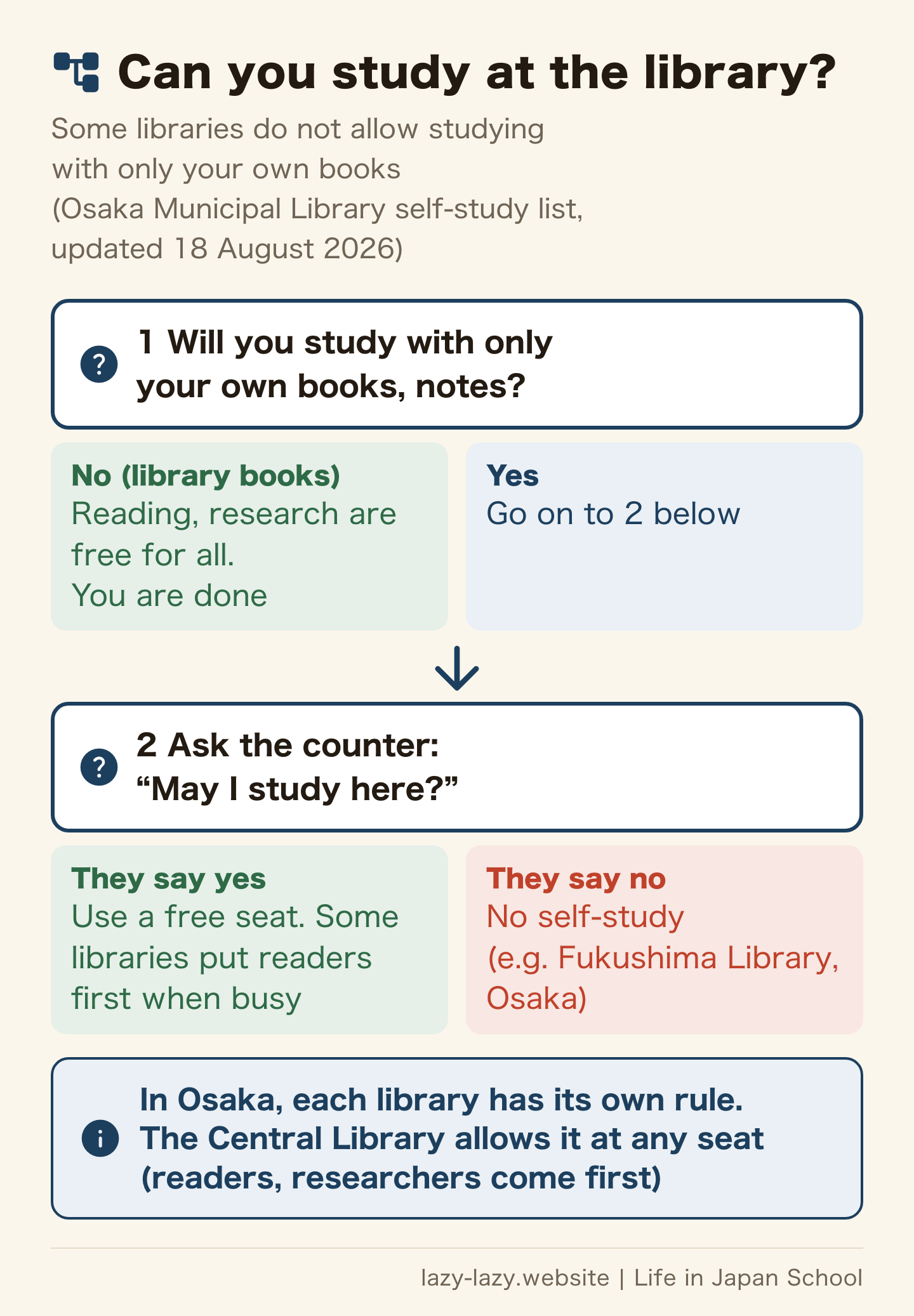
A library is a quiet place to do your own study. Where you come from, that may be normal. In Japan, some libraries do not allow jishu: studying only with your own textbooks and notes.
Osaka Municipal Library has long asked people not to study with only their own materials. Study using library books, or research, is free for all. On top of that, each ward now sets its own self-study rule (Osaka Municipal Library: self-study at each ward library).
- Central Library: you can study at any seat. Readers and researchers come first, and staff may ask you to stop when it is busy.
- Fukushima Library: self-study is not allowed.
- Tennoji Library: some seats allow self-study, some do not.
That is how much rules vary inside one city. At a new library, ask the counter before you start studying. “Koko de jishu shite mo ii desu ka?” (May I study here?) is enough.
Osaka Municipal Library added Wi-Fi to every branch in fiscal 2016. You can look up words on your phone while you read.
What helps you learn Japanese? Easy Japanese, your language, newspapers
The national government asks city libraries to offer guides and books in foreign languages. It also asks them to stock national and main local newspapers. These rules are in the education ministry’s standards. Each library differs, so here are examples.
- Easy-Japanese guides: Osaka and Yokohama have pages in easy Japanese. Osaka’s is “how to use the library”.
- Guides in your language: Osaka Central Library has user guides in English, Vietnamese, Portuguese and more.
- Books in your language: Osaka Central Library has books in Vietnamese and Nepali. It also has Hindi and Indonesian books (foreign-language materials).
- E-books: Osaka offers e-books for learning Japanese. With your card plus password, you can read them at home.
- Newspapers, dictionaries: Osaka says it stocks dictionaries, newspapers, maps and more.
For extensive reading (tadoku: reading lots of easy books), there are graded readers for learners. For example, Nihongo Tadoku Books are levelled readers for learners. They are on the Gifu Prefectural Library tadoku list. Type the title into the library’s search terminal to see if your city has them.
Reading alone will not give you speaking practice. For someone to talk with, look for a free or low-cost local Japanese class near you.
What if you return books late? Borrowing stops, lost books are replaced with the same book
The chart below puts the rules of 3 cities on one line. Each rule is for that city only: 8 days in Shinjuku, 15 opening days in Yokohama. Osaka contacts you.
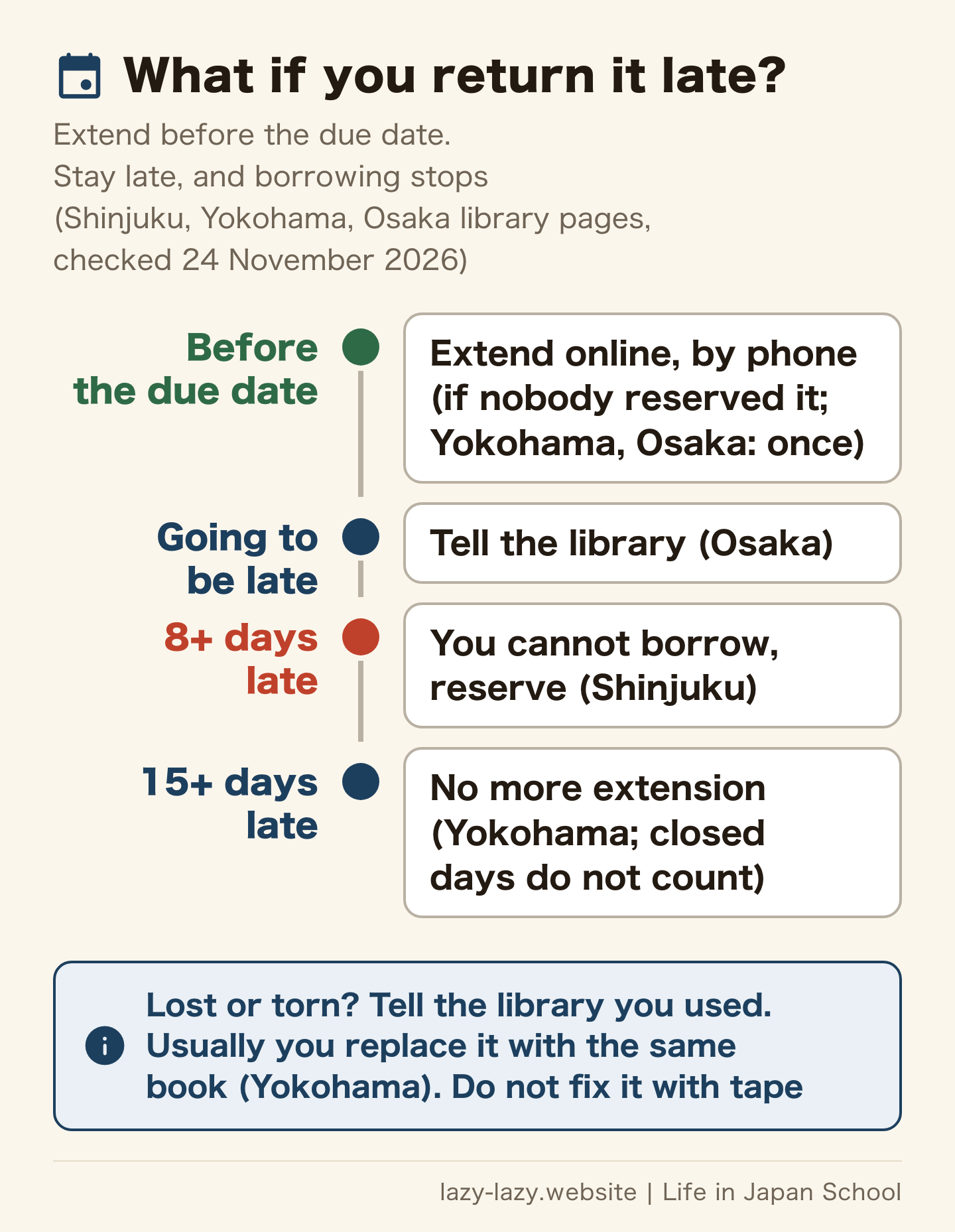
A late book keeps the next person waiting. In the 3 examples, staying late stops you from borrowing.
- Shinjuku: 8 or more days late, and you can no longer borrow or reserve.
- Yokohama: if you keep books a long time, you may lose borrowing and reserving. At 15 or more days late, counting only days the library is open, you cannot extend.
- Osaka: if you do not return books, the library contacts you to say “please return it”.
If you lose or damage a book, tell the library you borrowed it from. If it cannot be repaired, Yokohama usually asks you to bring the same book in its place (Yokohama City Library FAQ). Do not fix it with tape. Bring it as it is.
Do not lend your card to a friend. Shinjuku says it deletes your registration if it finds out you did.
Can’t make the due date, or can’t go in?
If you will be late, extend before the due date. You can do it online or by phone. Osaka asks you to call ahead if you will be late.
If you lose your card, tell the library right away. Yokohama reissues it the same day if you bring ID with your address (Yokohama City Library FAQ).
Moving also matters. Shinjuku deletes your registration if you no longer meet the rules after a move. In Osaka, a card you stop using stops working after a while. Return any borrowed books before you move.
Which one are you?
- You have no card yet: this week, take your residence card plus student ID to a library near your home or school. Get a card.
- You want to use the library near your school: today, check that city’s library site to see if students can join.
- You want to study at the library: next visit, ask the counter if self-study is OK before you start.
- You have a card but never borrowed: today, ask the counter where the easy Japanese books are. Borrow one.
Once you have a card and one borrowed book, you are done.
FAQ
Q. Can foreigners get a library card in Japan?
Yes. None of the 3 example guides set a nationality rule. What decides it is where you live, work or study.
Q. What do I need to get a library card?
One ID showing your name and current address. Each city lists different examples, so ask at the counter if your residence card is OK.
Q. Can international students get a card near their school?
In Shinjuku and Yokohama, people who study in the city can get one. If you do not live there, also show proof of your school, such as a student ID. Shinjuku needs a certificate of enrolment if your student ID has no address.
Q. Can I study with my own textbooks at the library?
It depends on the library. Osaka Central Library allows self-study at any seat. But readers come first, and staff may say no when it is busy. Fukushima Library in Osaka does not allow it.
Q. What happens if I return a book late?
In Shinjuku, 8 or more days late means you can no longer borrow or reserve. If you lose or damage a book, tell the library you borrowed it from.
Q. What happens to my library card if I move?
Inside the same city, tell the library to update your details. Yokohama needs ID with your new address. If you leave the city, Shinjuku deletes registrations that no longer meet its rules. In Osaka, unused cards stop working after a while.
Summary
Get your card in the city where you live, work or study. Search the city name plus “library” first, and check what to bring before you go.
Once you have the card, borrow one easy Japanese book. Put the return date in your calendar.
Sources (official): e-Gov Library Act / MEXT standards for public libraries / Shinjuku City Library registration, borrowing, returning, reservations, online services / Yokohama registration, borrowing, returning, guide in easy Japanese, FAQ / Osaka Municipal Library using the library in person, FAQ, how to use the library (easy Japanese), foreign-language materials, guides in many languages, self-study list (updated 18 August 2026) / Immigration Services Agency: what is a residence card? / Gifu Prefectural Library: Japanese tadoku list (all checked 24 November 2026).
Related reading
Found this useful? Share it
Send it to a friend who lives in Japan.
WHO WROTE THIS
mori
Japanese. I read the ministries’ own notices, orders and Q&As in the original, and I start from what my Nepalese and Sri Lankan friends in Japan actually ran into. I do not write about what I have not checked or been told.
What this site can and cannot do →Looking for something else?
You may use the figures in this article, including commercially, if you credit this site with a link. How to use our figures