SKILL 3 ・ EARN ・ 稼ぐ力
Better skills, better rate.
What you earn is what you can do × the hours you can work × the rules that allow it. For a foreigner, that third one is your residence status. Get it wrong and you lose more than income — you lose the right to be here.
Why Earn comes third
Most people want to start here. The order is backwards. Earning while your foundation is weak means losing what you earn. Pouring water into a bucket full of holes does not fill it.
And once your spending is under control, everything extra you earn actually stays. That is why Protect and Save come first.
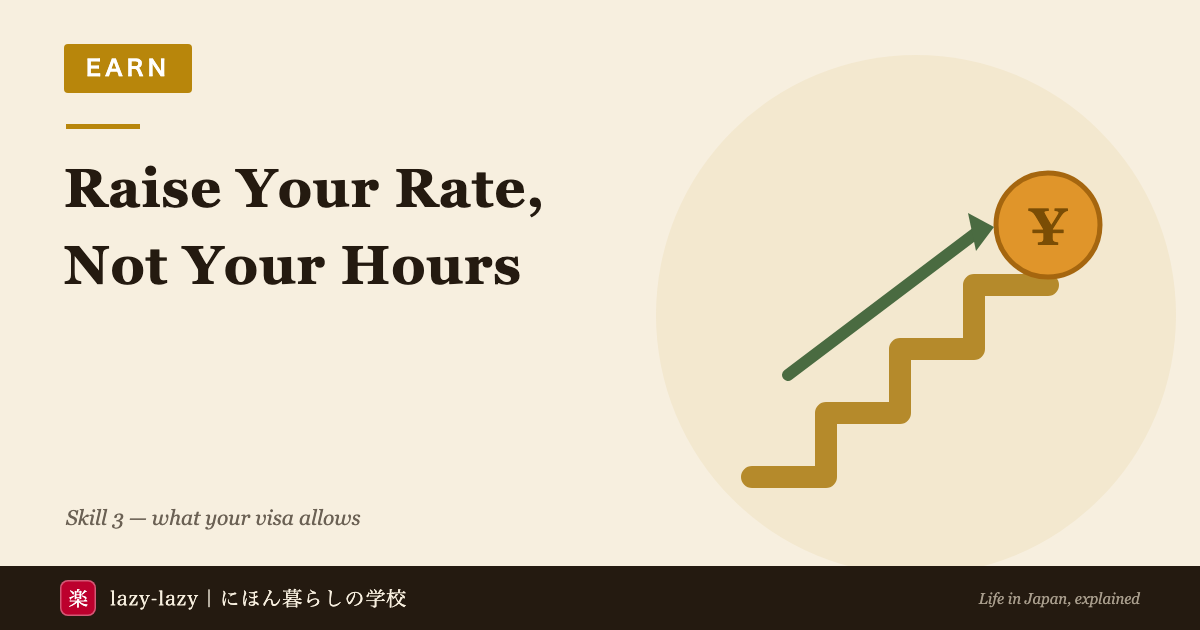
There are only two ways to earn more: more hours, or a higher rate. Hours are limited — and for foreigners they are limited twice, by the day having 24 of them and by rules like the 28-hour weekly cap. So the thing to grow is your rate.
Your residence status is the biggest variable
Two people with identical skills can be allowed to earn very different amounts, purely because of their status. That is not about ability. It is about rules.
Students have a 28-hour weekly limit. Work visas define the kind of work you may do. Status-based residence (spouse of a Japanese national, permanent resident) has no restriction at all. The dangerous position is not knowing which one you are in.
And the single most reliable way to raise your rate here is Japanese. Same job, same shift — but what you get trusted with changes, and the pay follows.
This skill still works after you leave Japan
The 28-hour rule, and the name of a visa category like “Engineer / Specialist in Humanities / International Services”, mean nothing outside Japan. Given enough time, they will change inside Japan too.
These four do not change:
- Check what you are allowed to do before you start doing it. Every country has rules about what foreigners may work at
- Raise your rate rather than your hours. Hours have a ceiling; skill does not
- Adding one language changes the work you get offered
- Keep one way of earning that does not depend on an employer
Japanese itself may matter less once you go home. But you will still have done it — taken a language from zero to the point where you could work in it. That method stays with you, for the next language, and for your children when they do the same thing.
Earn — the guides
Start here. Know your own ceiling before you plan anything else.
Part-time jobs for students: the 28-hour rule
How to find work, what it pays, and what happens if you go over.
Keigo vs casual Japanese: what to say at work
How you speak decides what you get trusted with. Diagrams, not grammar drills.
Learn kanji with Japanese school drills
Six grades is 1,026 characters, close to N2. Print them and it costs nothing.
Student visa to work visa: why some applications fail
The reasons are predictable, which means you can remove them in advance.
Work in Japan without a degree: three routes
No university degree does not mean no career. Only the road changes.
Getting a driving licence in Japan
Whether you can drive changes which jobs you can apply for at all.
Start a blog in Japan
One way of earning that no employer controls — and it comes home with you.
Official source: Ministry of Health, Labour and Welfare: employment support for foreign residents
Once your income is rising, go to the next step
The next skill is Grow — making money work instead of only you working. For foreigners there is a catch worth knowing early: some of it only works while you live in Japan.
The five skills | All guides in English | About this site
Found this useful? Share it
Send it to a friend who lives in Japan.
WHO WROTE THIS

mori
Japanese. I read the ministries’ own notices, orders and Q&As in the original, and I start from what my Nepalese and Sri Lankan friends in Japan actually ran into. I do not write about what I have not checked or been told.
What this site can and cannot do →Looking for something else?