Checked on 7 November 2026 against the text of the Act on Specified Commercial Transactions and other laws (e-Gov), Consumer Affairs Agency guidelines and commentary, the Ministry of Internal Affairs and Communications guideline, and official pages of the National Consumer Affairs Center of Japan, Tokyo, Osaka City, Osaka Prefectural Police and NHK.
The short answer
- Door-to-door sales means a business selling away from its shop, usually at your home. Under the law it also covers street touts who walk you to a shop.
- To say no, one word is enough: “Irimasen” (いりません, “I don’t need it”). You owe no reason. Pitching to someone who has refused is banned by law.
- “I’m busy now” only refuses that moment. “Kekkou desu” counts as no, but sellers have claimed it meant yes, so avoid it.
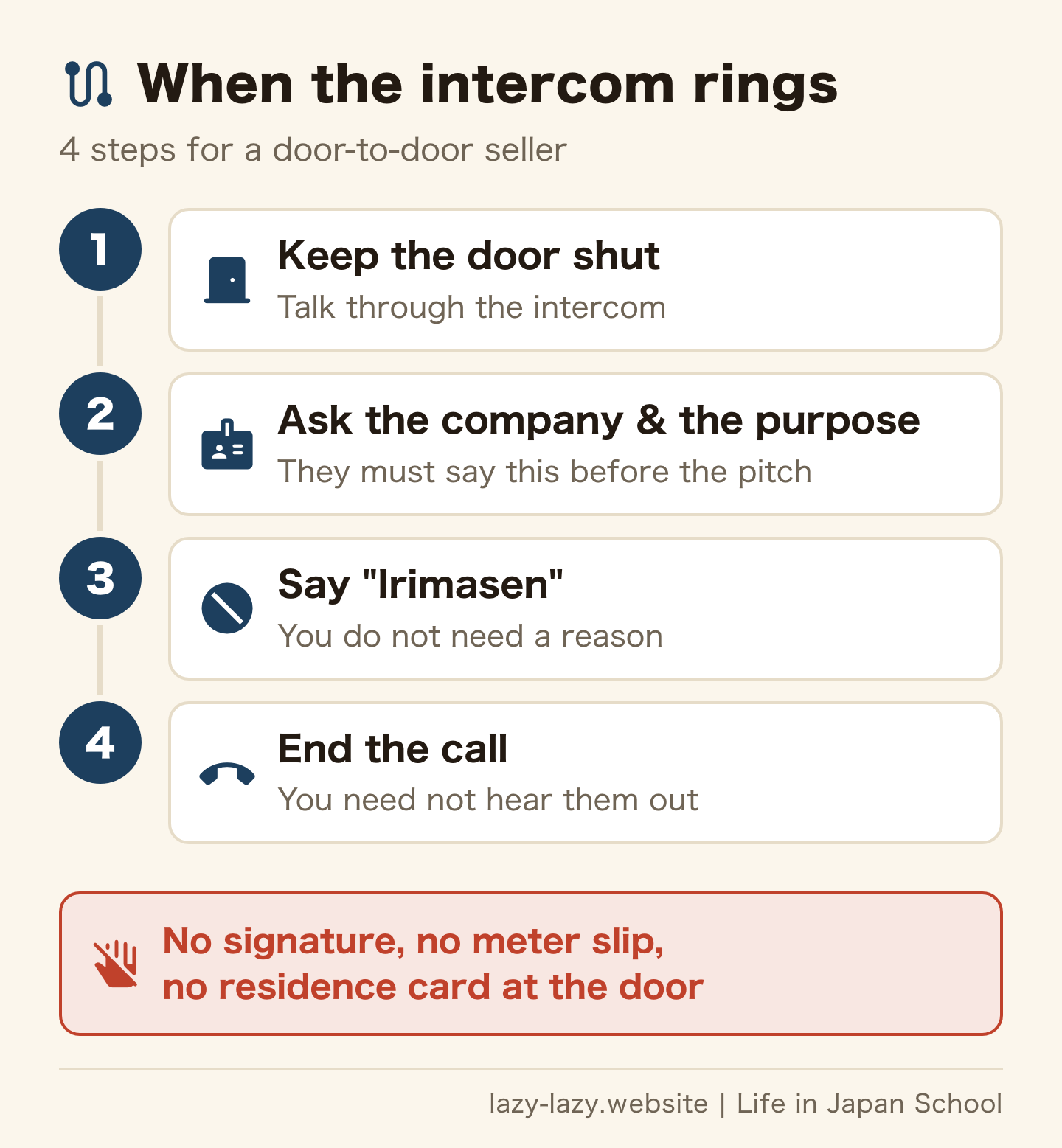
- Do not sign at the door. Do not show your meter-reading slip or your residence card either.
- If they stay, say “Kaette kudasai” (please leave). If they still stay, call 110. For advice afterwards, call 188.
Knowing this, you can end the conversation in one word, even if you cannot follow the Japanese. Whatever they say, you can stop before you sign.
Saturday morning, and the intercom rings. On the screen is a stranger with a name badge. The Japanese comes fast, and you catch three words: electricity, cheaper, apartment. Is it rude not to open the door? Does saying “hai” make it a contract? Which words actually count as no? You do not know, and the explanation keeps going.
- How do you refuse door-to-door sales in Japan? 7 phrases for the intercom
- Do “kekkou desu” and “I’m busy” count? The words change how the law treats you
- Who is this salesperson? Checking the company name and ID
- “Just sign here”: why you do not sign at the door
- Electricity, internet service, solar, newspapers: what you may hear and where to check
- What if they will not leave after you refuse? It can be a crime
- Are late-night sales visits illegal? 9 p.m. to 8 a.m. often counts as a nuisance
- What does the law ban in door-to-door sales, and what happens to sellers?
- How do you refuse sales calls? “Irimasen. Mou denwa shinaide kudasai”
- How do you get rid of street touts in Japan? Keep walking and say “Irimasen”
- Can you refuse NHK at the door? That is a different matter
- Who do you call, and what does it cost? 188, 110 and the reporting form
- Which one are you?
- FAQ
- Summary
- Related reading
How do you refuse door-to-door sales in Japan? 7 phrases for the intercom
The intercom rings and the pitch begins. Where you come from, it may be polite to hear someone out. In Japan, you can say “Irimasen” in the middle of their sentence.
“Irimasen” is the only phrase you need. It is one of the refusals named in the Consumer Affairs Agency’s guideline (in Japanese). None of its examples comes with a reason attached.
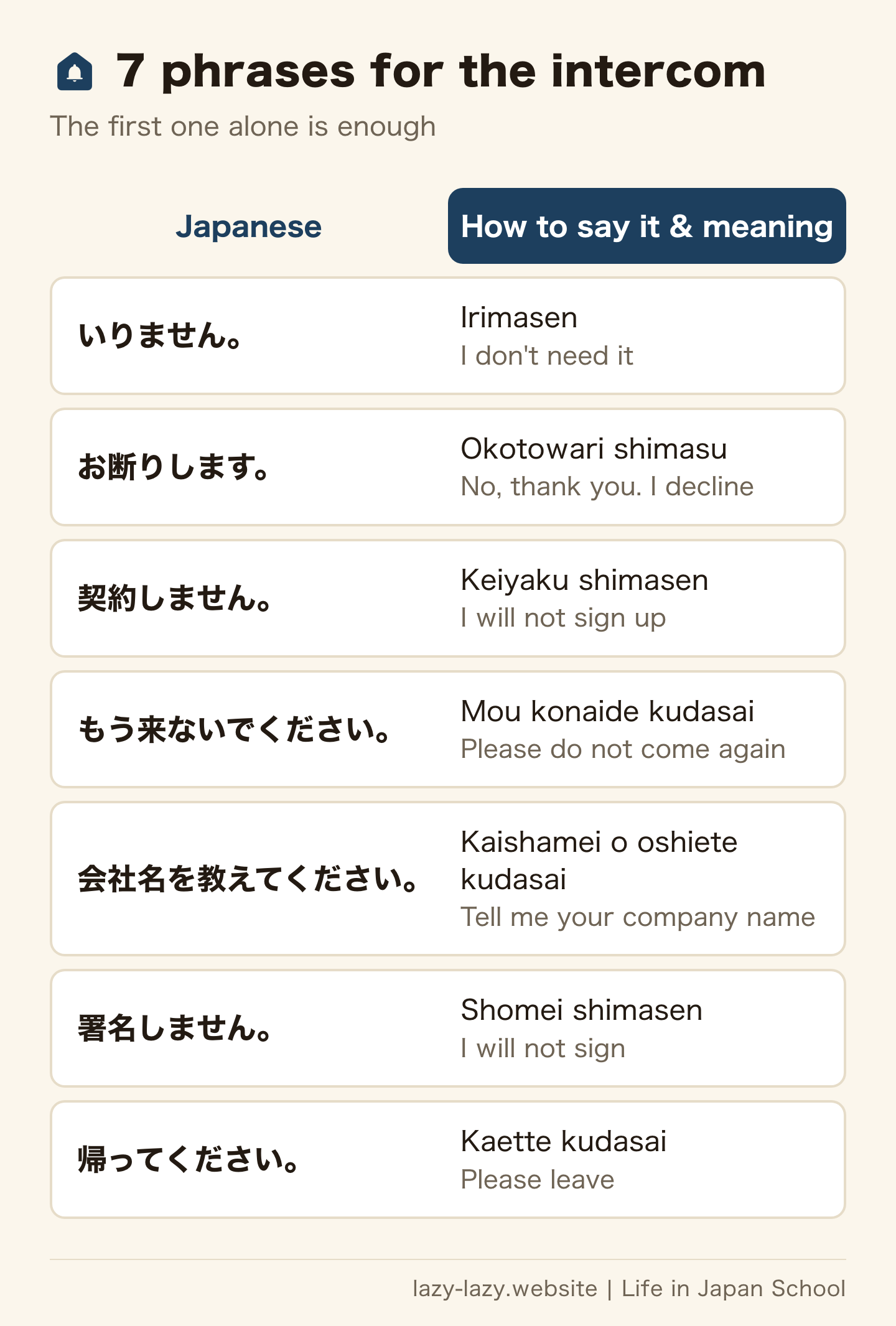
Naming the thing makes it stronger. The guideline says “I don’t need a water purifier” refuses all water purifiers, not just that model. Put the word you caught in front: “Denki wa irimasen” (no electricity offer for me).
Not answering the intercom is also an option. But you have not refused, so the ban on repeat visits below does not apply. If they keep coming, answering once ends it sooner.
Do “kekkou desu” and “I’m busy” count? The words change how the law treats you
You have refused once you clearly show you will not sign up. Article 3-2 of the Act on Specified Commercial Transactions bans pitching to such a person. That covers carrying on at the door and coming back another day. The guideline says it also covers a different employee of the same company.
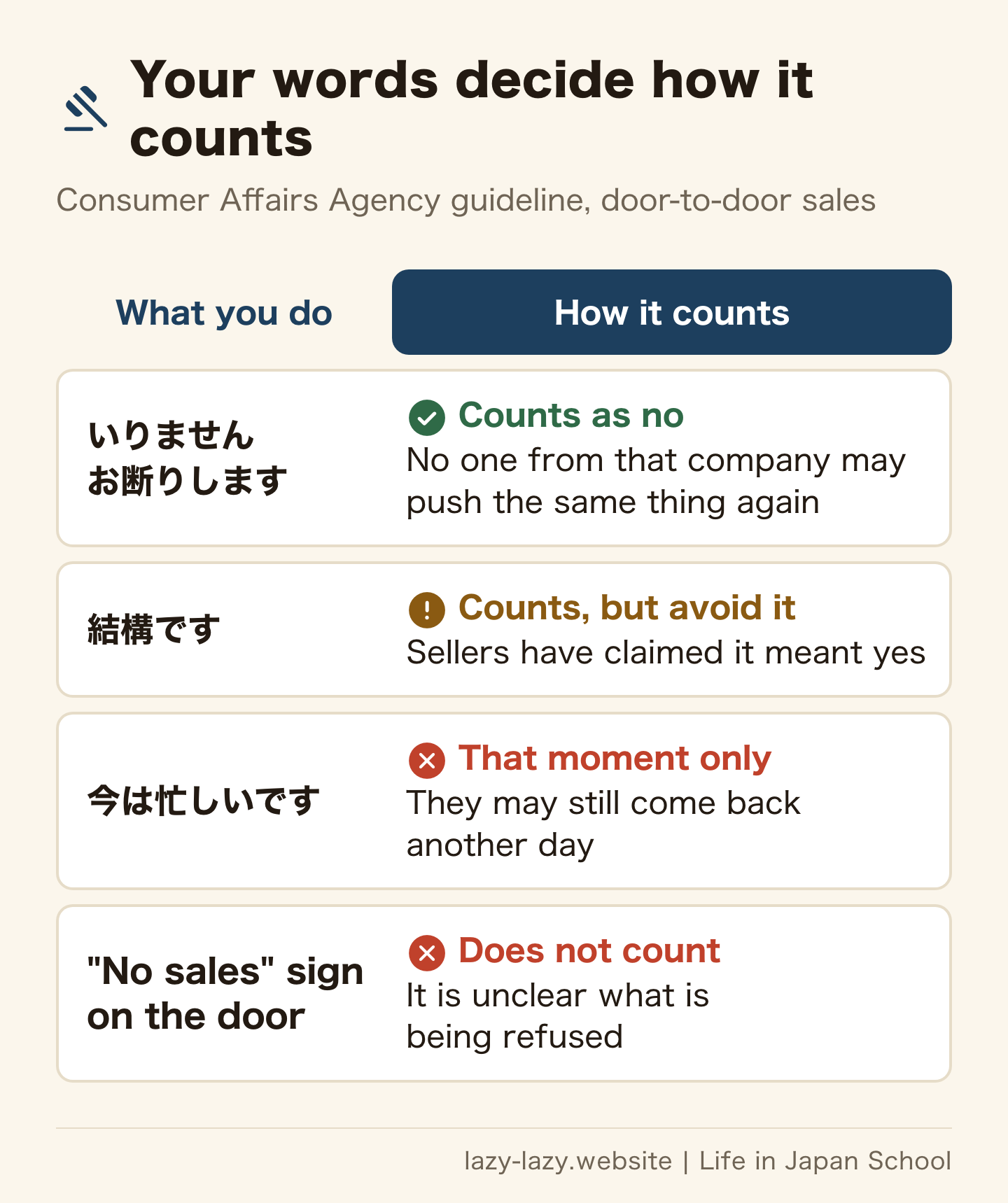
“Kekkou desu” is listed in the guideline as a refusal. The same page notes many cases where sellers claimed it meant yes. If your Japanese is shaky, leave it out.
“I’m busy now” on its own does not stop them coming another day. “I don’t understand Japanese” is not among the guideline’s examples either. If you say it, add “Irimasen”.
Some things stay allowed after you refuse. They may offer a different product. Pitching to someone else in your household is not automatically illegal. After a reasonable time, it may count as a new contract. Each time, the same word is enough.
Who is this salesperson? Checking the company name and ID
Before pitching, a seller must tell you three things: the company name, that the aim is to sell, and what kind of product it is (Article 3). The Agency’s official notice says that at a home this should come first, over the intercom. A personal name alone or a nickname for the company is not enough. Saying “I’m here to check your pipes” and then selling repairs is one of its examples of a violation.
An ID card is different. The same notice says showing one is not a legal duty. So refusing to show ID is not illegal in itself. And seeing an ID is no reason to keep listening.
Say “Kaishamei o oshiete kudasai” (tell me your company name). If they will not answer, end the talk. If they do, do not call a number they give you. Call the number on your bill or the official website yourself. The National Consumer Affairs Center reports sellers posing as a power company’s affiliate.
“Just sign here”: why you do not sign at the door
They hold out a form and say it is only to confirm the visit. Where you come from, signing for something small may be normal. In Japan, do not sign a paper you cannot read. The Center’s leaflet for foreign residents says the same: do not sign a contract you do not fully understand.
The phrase is “Shomei shimasen” (I will not sign). Not signing is not a complete shield, though. In principle a contract needs no paper to exist (Civil Code, Article 522). Do not answer “hai” to questions you cannot follow. Go back to “Irimasen”.
Two things stay out of sight as well.
- Your meter-reading slip (the paper showing your power or gas use): it carries the numbers needed to switch your contract. Say “Kenshinhyou wa misemasen” (I won’t show the slip).
- Your residence card: you must show it when officials such as immigration officers and police ask for it in the course of their duties (Immigration Act, Article 23). Salespeople are not on that list.
If you already signed, act today. Within 8 days of receiving the document, the cooling-off rule may let you cancel. For internet line contracts the rule is not cooling-off but initial contract cancellation: send a postcard or other written notice within 8 days of receiving the contract document, or a similar start date. No penalty applies, but you may be charged for the service you used, construction work and admin fees. Cooling-off itself may still work after 8 days if lies or threats stopped you or the document has defects.
Electricity, internet service, solar, newspapers: what you may hear and where to check
Switching power company or getting fibre internet is not illegal. If you want one, you can compare and apply yourself after saying no. The problem is the pressure. Power and gas complaints tend to rise from New Year to early spring, and among younger people nearly 80% involve door-to-door sales.
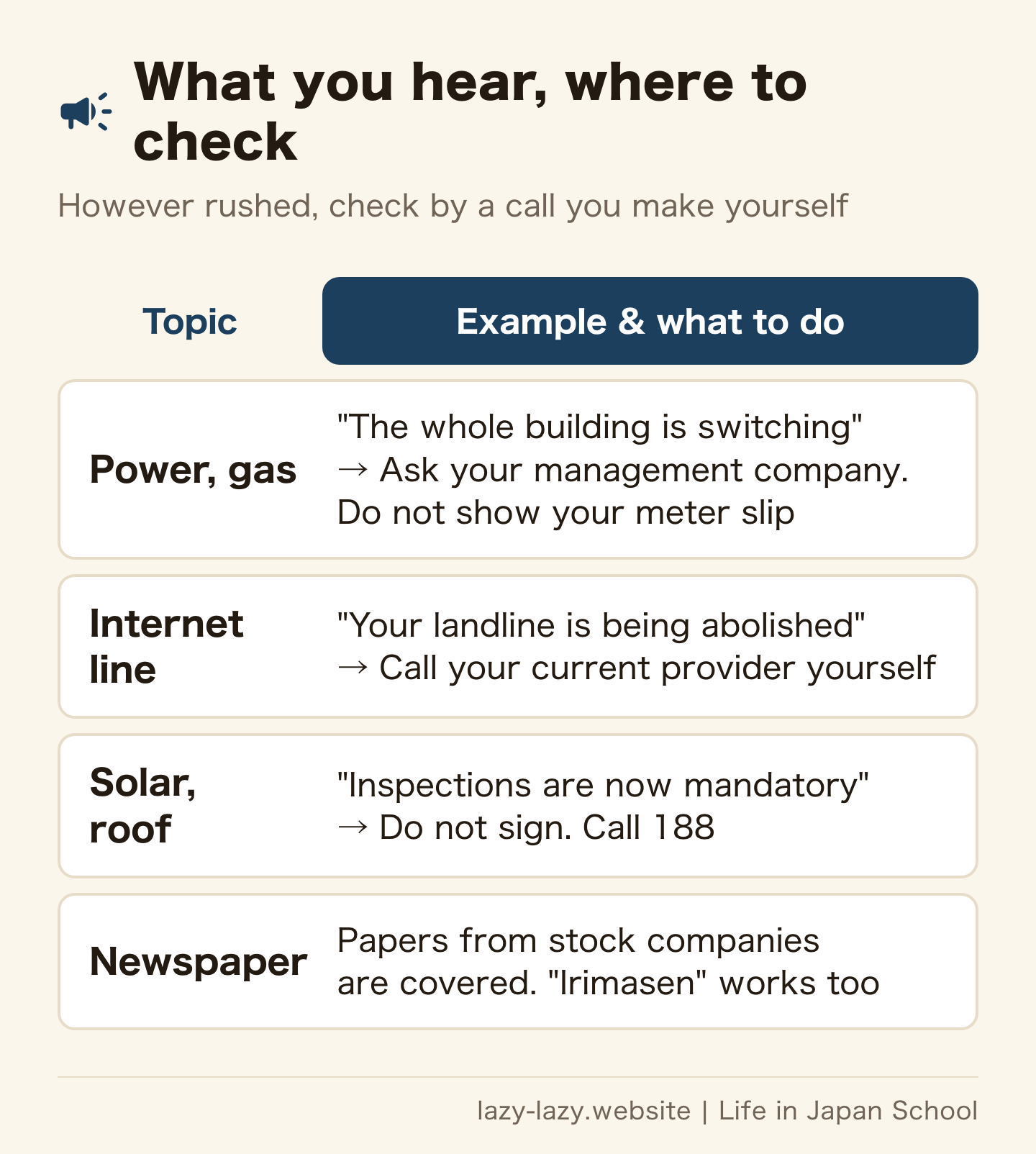
- Power and gas: the leaflet names “the whole building is switching” as a lie. You choose your own electricity contract, and your management company can confirm this.
- Internet line: a different law applies. Telecoms carriers’ services are excluded from the Act on Specified Commercial Transactions (enforcement order, Appended Table 2, item 31). Instead, the Telecommunications Business Act bans continuing to pitch after a refusal. Under the ministry guideline, “Meiwaku desu” (this is a nuisance) counts too. Sales agents must follow this as well, but a different agent coming is not banned. If one comes, say the same word.
- Solar, batteries, roofs: if told “inspections are now mandatory”, the Center says not to sign up lightly. Complaints about inspection-style selling reached 19,696 in fiscal 2025. If you rent, pass anything about the building to the management company.
- Newspapers: papers published by a stock company fall under the Act. Those from other kinds of publisher are excluded (Article 26).
What if they will not leave after you refuse? It can be a crime
Someone who stays after “Kaette kudasai” may be committing an offence under Article 130 of the Penal Code. Staying in a home or similar place without good reason after being told to leave carries up to 3 years in prison or a fine of up to 100,000 yen. If they are only outside the door, stop talking, lock it and walk away.
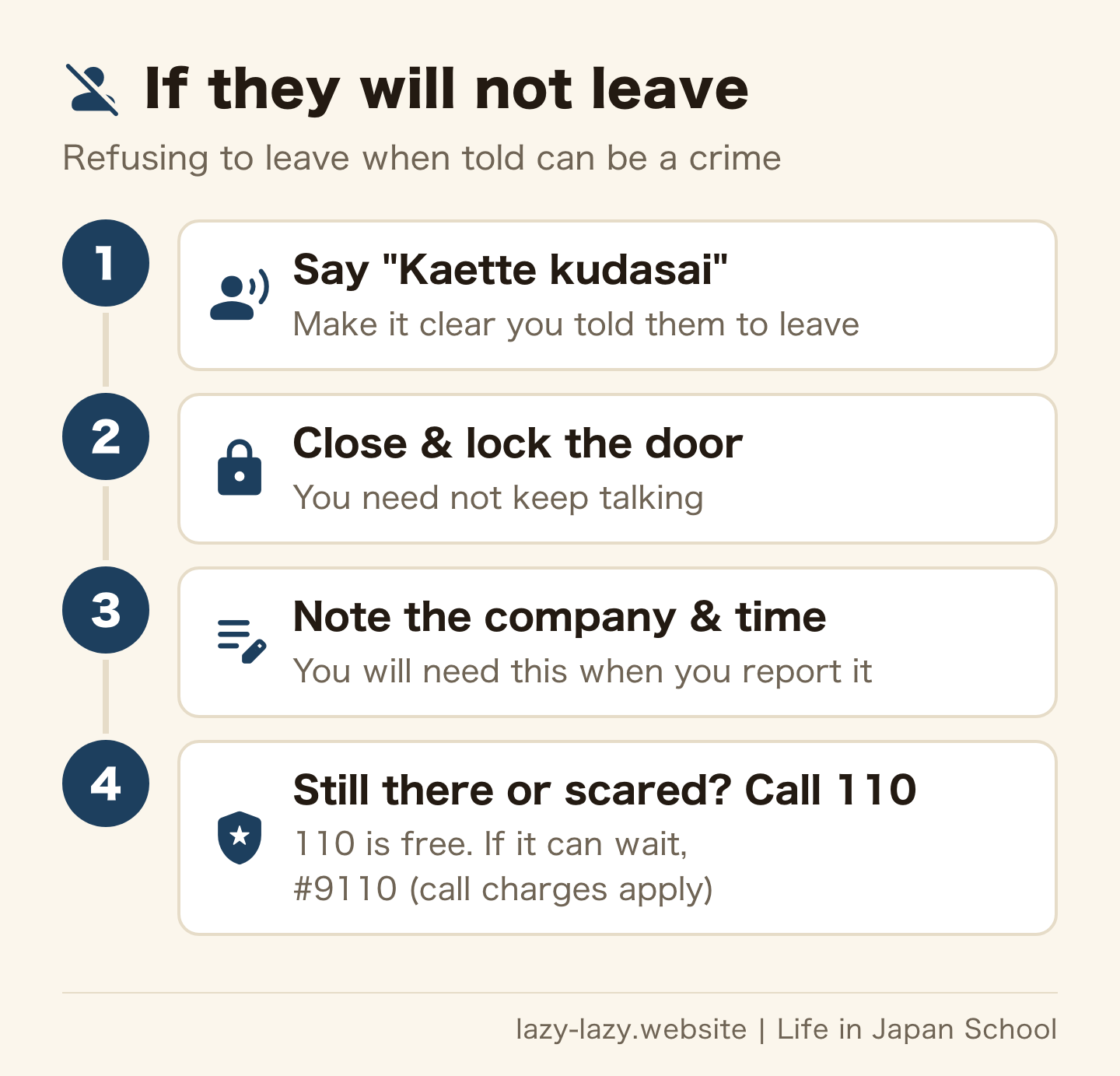
Calling 110 costs nothing. If you are scared, call. For police matters that can wait, there is #9110 (basically weekdays 8:30 to 17:15, varying by prefecture; you pay for the call). An interpreter joins 110 calls if you cannot speak Japanese.
There is a way back even if you signed under that pressure. If they stayed after you told them to go, and you signed because of it, you can cancel under Article 4(3) of the Consumer Contract Act. There is a time limit: 1 year from when you are out of that situation and 5 years from the contract (Article 7). To check your own case, call 188.
Are late-night sales visits illegal? 9 p.m. to 8 a.m. often counts as a nuisance
The law sets no exact hour. Article 18 of the enforcement rules bans selling in a way that causes a nuisance. The Agency’s commentary says selling between 9 p.m. and 8 a.m. without good reason often counts.
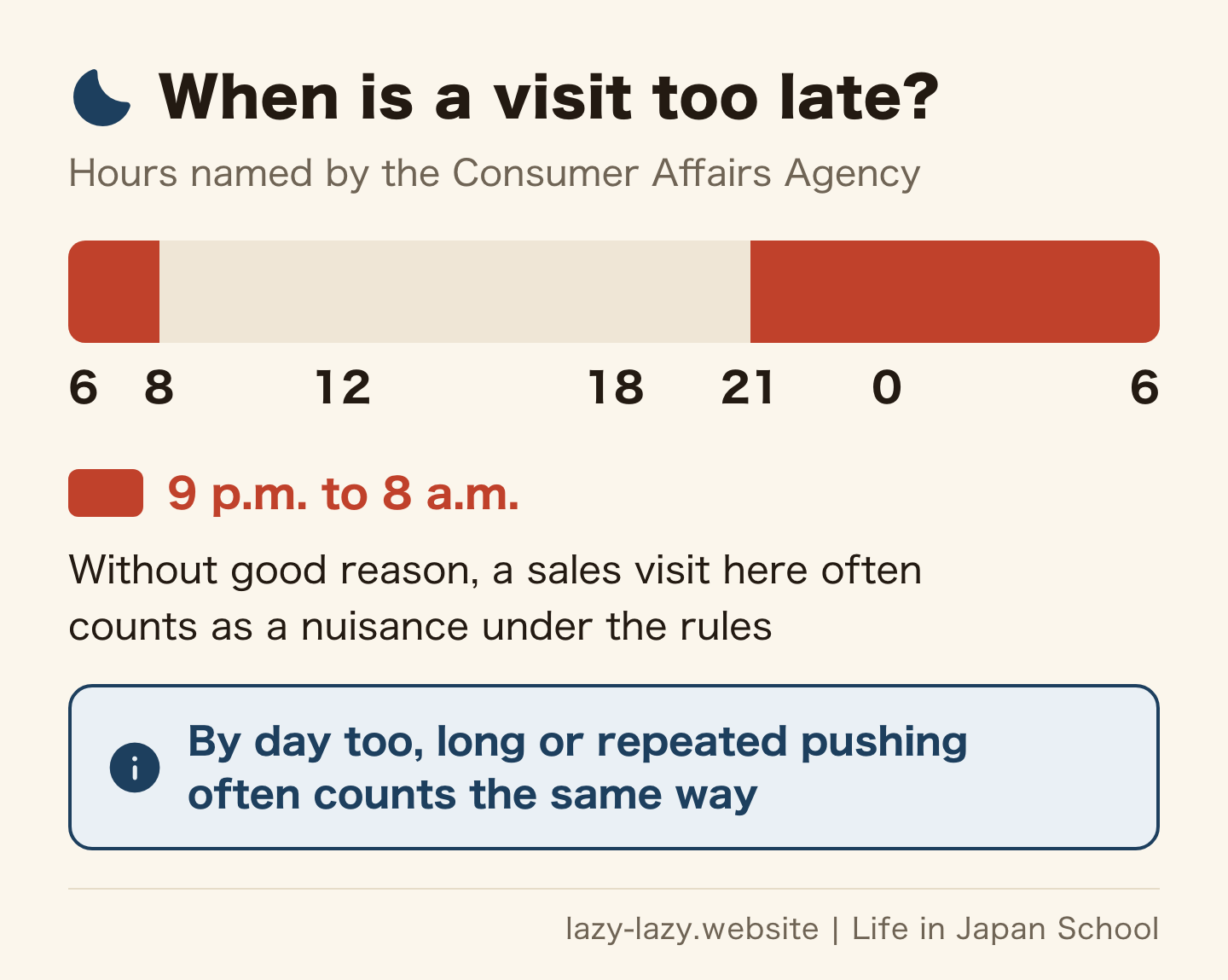
Long pitches and repeated visits are on the same list. If someone comes at night, stay silent or say only “Irimasen”. Note the time and the company for later.
What does the law ban in door-to-door sales, and what happens to sellers?
| Banned | Basis (Act on Specified Commercial Transactions) |
|---|---|
| Pitching without giving the company, the purpose & the product type | Art. 3 |
| Carrying on, or coming back, after you refuse | Art. 3-2 |
| Lying, or hiding important facts on purpose | Art. 6(1), (2) |
| Intimidating you | Art. 6(3) |
| Luring you without saying why, then pitching where the public cannot enter | Art. 6(4) |
| Pitching in a way that causes a nuisance (late, long, repeated) | Art. 7(1)(v); Rules Art. 18(i) |
| Blocking your way or following you in the street | Art. 7(1)(v); Rules Art. 18(vii) |
A company that breaks these rules can face orders or a business suspension. Lies and intimidation carry criminal penalties: up to 3 years in prison or a fine of up to 3 million yen, or both (Article 70). Repeat pitching is first a matter for administrative action. Ignoring an order brings penalties under Article 71.
None of this falls on you. The duties in this Act are the seller’s, and refusing costs you nothing.
The Act does not cover every kind of selling. Real estate, financial products and some others are outside it under Article 26(1)(viii). You can still say the same word.
How do you refuse sales calls? “Irimasen. Mou denwa shinaide kudasai”
The phone works the same way. A caller must first give the company, their own name, the product type and the fact that it is a sales call (Article 16). Article 17 bans pitching to someone who has refused.
Say “Irimasen. Mou denwa shinaide kudasai” (I don’t need it. Please do not call again). Then hang up. The guideline says repeatedly hanging up without answering can count as a refusal too.
On the phone, a vague answer is the biggest risk. A ministry flyer warns that a fibre contract can be formed by phone alone. It also says not to follow instructions on your computer and not to pass on a “tenyou shoudaku bangou” (conversion approval number). “NTT’s landline is being abolished” is its example of a false pitch.
Late-night, early-morning and very long calls, and calls to your workplace, often count as a nuisance, unless you have agreed to them. A caller claiming to be the police or Immigration and asking for money is not a salesperson. See how to spot those scams and who to call.
How do you get rid of street touts in Japan? Keep walking and say “Irimasen”
“Catch sales” means stopping people in the street and taking them to a shop to sign. Tokyo’s explanation says speaking to you is not illegal in itself. Blocking your way or following you is banned.
Say “Irimasen” as you walk. Do not go inside, even for a “survey” or “free” talk. Luring you without giving the purpose, then pitching where the public cannot enter, is banned under Article 6(4). Being called out through social media without being told it is a sale also counts as door-to-door sales.
Bar and izakaya touts fall under local rules. Osaka City, for example, bans touting people in public places after they refuse. Osaka police advise not following touts, because some lead to places that charge outrageous prices. They also advise against swapping contact details easily, because some scouts pose as people trying to pick you up.
Can you refuse NHK at the door? That is a different matter
An NHK visitor is not selling you a product. According to NHK, anyone with equipment that can receive it, or who has started its online service, is to sign a reception contract. NHK says the fee is not optional. Saying “Irimasen” does not remove that duty. Broadcasters’ broadcasting is on the list of exclusions from the Act on Specified Commercial Transactions.
NHK’s visitors carry an ID, so ask to see it first. If you have no TV and do not use the online service, you have no duty to sign. For the steps and the student exemption, see the NHK fee guide.
Who do you call, and what does it cost? 188, 110 and the reporting form
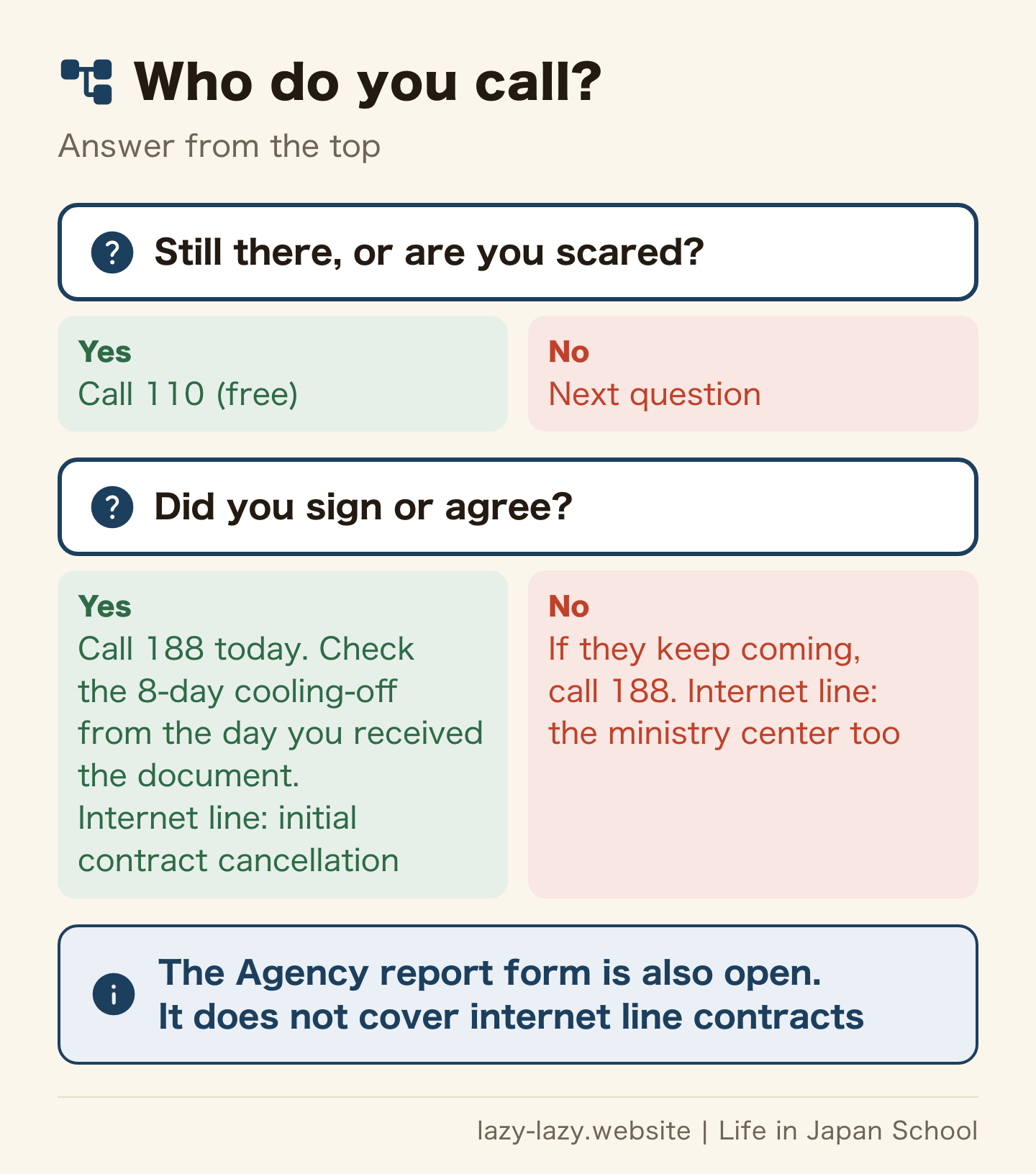
| Contact | When | Cost |
|---|---|---|
| 110 | They will not leave, they threaten you, you are scared | Free |
| #9110 | A police matter that can wait (basically weekdays 8:30 to 17:15, varying by prefecture) | You pay for the call |
| 188 (Consumer Hotline) | They keep coming, you signed, you are worried about a contract | Advice is free; you pay for the call |
| The Agency’s reporting form (in Japanese) | You want to report a violation of the Act on Specified Commercial Transactions. Internet service contracts are not covered | Free web form |
Refusing costs nothing. Whether 188 can help in another language depends on the area. If Japanese is hard, use the helplines listed by language. The form feeds investigations and will not settle your own problem. For that, call 188. For internet service sales, call 188 or the Ministry of Internal Affairs and Communications Telecom Consumer Consultation Center (03-5253-5900, Mon to Fri, 9:30 to 12:00 and 13:00 to 17:00, except holidays and New Year). The center gives advice but does not mediate.
Which one are you?
- Nothing has happened yet: today, say “Irimasen” out loud once.
- You refused through the intercom: nothing more to do. Today, note the company name if you got it.
- The same company came back after you refused: today, note the date and company, then call 188.
- They will not leave, or you are scared: call 110 now.
- You signed or showed your meter slip: today, call 188 and check the day you received any paper.
FAQ
Q. Can I just ignore the intercom?
You can. But it does not count as refusing, so the ban on repeat visits does not apply. If they keep coming, saying “Irimasen” once ends it sooner.
Q. Is it rude not to give a reason?
You do not need one. The refusals named in the Consumer Affairs Agency guideline, such as “Irimasen” and “Okotowari shimasu”, come with no reason attached.
Q. Does a “no sales” sticker work?
Not under the ban on repeat pitching. A sign saying only “no door-to-door sales” does not count as a refusal, because it is unclear what is being refused. Refuse in words when they come.
Q. Are sales visits after 9 p.m. illegal?
No article sets an exact hour. The Agency’s commentary says selling between 9 p.m. and 8 a.m. without good reason often counts as a nuisance.
Q. Do I have to show a salesperson my residence card?
No. Under Article 23 of the Immigration Act you must show it when officials such as immigration officers and police ask for it in the course of their duties. Salespeople are not on that list.
Q. I already signed. What now?
Call 188 today. For door-to-door and phone sales, you may be able to cancel by cooling-off within 8 days of receiving the document. Internet line contracts use initial contract cancellation instead, also within 8 days of receiving the contract document or a similar start date.
Summary
To refuse door-to-door sales in Japan, say “Irimasen” through the intercom. You owe no reason. Once you refuse, carrying on and coming back with the same offer are both banned. “I’m busy” does not stop them coming another day, and a door sign does not count as a refusal.
Do not sign, and do not show your meter slip or residence card. If they stay, say “Kaette kudasai”. If they still stay, call 110. If you already signed, call 188 today.
Official sources (in Japanese unless noted): e-Gov, Act on Specified Commercial Transactions / enforcement rules / enforcement order / Consumer Affairs Agency, Article 3-2 guideline / official notice / commentary, door-to-door sales / commentary, telemarketing / guide, door-to-door sales / guide, telemarketing / Consumer Hotline / Ministry of Internal Affairs and Communications guideline / fibre phone sales flyer / National Consumer Affairs Center, leaflets for foreign residents (multilingual) / electricity & gas contract trouble / inspection-style selling / solar inspection selling / home battery selling / Consumer Affairs Agency reporting form / Ministry telecom consultation / Ministry telecom help list / Tokyo, catch sales / Osaka City touting ordinance / Osaka Prefectural Police on illegal touting / National Police Agency, helpline list / Tokyo Metropolitan Police consultation center / National Consumer Affairs Center, cooling-off / NHK / e-Gov: Civil Code, Penal Code, Consumer Contract Act, Telecommunications Business Act, Immigration Act (all checked 7 November 2026). To see how this applies to you, call 188.
Related reading
Found this useful? Share it
Send it to a friend who lives in Japan.
WHO WROTE THIS

mori
Japanese. I read the ministries’ own notices, orders and Q&As in the original, and I start from what my Nepalese and Sri Lankan friends in Japan actually ran into. I do not write about what I have not checked or been told.
What this site can and cannot do →Looking for something else?
You may use the figures in this article, including commercially, if you credit this site with a link. How to use our figures